
All APIs
0.45¢ per article19 datapoints
Twitter Articles API
Long-form X (Twitter) Articles with title, preview text and the full article as text and Markdown. Pass the article URLs.
Sample
Sample data
Here's a sample run of 5 articles, showing the exact schema and results you can expect.
| # | Tweet URL | Tweet ID | Article ID | Title | Preview Text | Article Text | Article Markdown | Content Blocks | Posted Date | Lifecycle | Views | Likes | Retweets | Replies | Quotes | Bookmarks | Cover Image | Author ID | Author |
|---|---|---|---|---|---|---|---|---|---|---|---|---|---|---|---|---|---|---|---|
1 | 2036639365498335463 | 2036598356211015680 | クリエイター収益10万円増額!𝕏 記事コンテスト開催 | Xでは才能あふれるライターの皆さんによる高品質な記事投稿が現在どんどん増えていることをとても嬉しく思います——そしてその勢いはますます加速しています! 今月から、X Corp. Japan は毎月(3月から開始)、その月に投稿された記事からTop 10を選出します。
(終了日未定:終了の際は事前にお知らせします) ユーザーエンゲージメントと定められた基準を基に選び、Top 10の受賞者には特別にク | Xにいる日本のクリエイターの皆さんへ朗報です!
Xでは才能あふれるライターの皆さんによる高品質な記事投稿が現在どんどん増えていることをとても嬉しく思います——そしてその勢いはますます加速しています!
今月から、X Corp. Japan は毎月(3月から開始)、その月に投稿された記事からTop 10を選出します。
(終了日未定:終了の際は事前にお知らせします)
ユーザーエンゲージメントと定められた基準を基に選び、Top 10の受賞者には特別にクリエイター収益を10万円増額して還元します。
応募資格(以下のすべてを満たすこと)
Xの記事機能にて日本語で執筆され、1,000文字(全角)以上の長さであること
応募者本人が作成したオリジナルで未発表の作品であること(AI生成または大幅にAI支援を受けた内容は不可。ただし明示的に許可された場合を除く)
小説(フィクション)・ノンフィクションのいずれも可
過去に公開・商業利用されていないこと
違法薬物、危険行為、悪質ないたずら、猥褻・下品な表現、ヌード、ヘイトスピーチ、差別、政治・宗教に関する主張、名誉毀損、盗用、無許可の著名人肖像、ブランド広告(𝕏所有のものを除く)など、第三者の権利を侵害する内容や禁止事項を含まないこと(Xのルールとポリシーに遵守)
Xの利用規約および画像・コンテンツ基準に完全に準拠していること
選考方法
毎月末に、当該月に投稿された対象記事すべてを以下の基準で評価します:
応募資格を満たしているか
文法・表記・技術的な完成度
独創性と独自性
プラットフォームでのエンゲージメント(ホームタイムラインのインプレッション数を中心に検証)
受賞者にはダイレクトメッセージ または @mention で通知します。
賞の受け取りには、通知から2営業日以内(土日祝日は除外)にご返信ください。
期限内に連絡がない場合、賞は次点の方へ回るか未授与となる可能性があります。
報酬は既存のクリエイタープログラムを通じて Stripe で支払われます。
受賞者は、クリエイターアカウントに有効なStripeアカウントをリンクする必要があります。
まだクリエイタープログラムに参加していない方は、条件を満たしていれば審査のうえ参加資格を提供します。
これは、𝕏上で生まれる優れた日本語の記事を称え、報酬としてしっかりと還元していくための取り組みです。
ぜひ、最高の作品を執筆・投稿してください! | ## **Xにいる日本のクリエイターの皆さんへ朗報です!**
Xでは才能あふれるライターの皆さんによる高品質な記事投稿が現在どんどん増えていることをとても嬉しく思います——そしてその勢いはますます加速しています!
今月から、**X Corp. Japan** は毎月(3月から開始)、**その月に投稿された記事からTop 10**を選出します。\
(終了日未定:終了の際は事前にお知らせします)
ユーザーエンゲージメントと定められた基準を基に選び、Top 10の受賞者には**特別にクリエイター収益を10万円増額**して還元します。
---
## **応募資格(以下のすべてを満たすこと)**
- **Xの記事機能にて日本語で執筆**され、**1,000文字(全角)以上**の長さであること
- 応募者本人が作成した**オリジナルで未発表**の作品であること(AI生成または大幅にAI支援を受けた内容は不可。ただし明示的に許可された場合を除く)
- 小説(フィクション)・ノンフィクションのいずれも可
- 過去に公開・商業利用されていないこと
- 違法薬物、危険行為、悪質ないたずら、猥褻・下品な表現、ヌード、ヘイトスピーチ、差別、政治・宗教に関する主張、名誉毀損、盗用、無許可の著名人肖像、ブランド広告(𝕏所有のものを除く)など、第三者の権利を侵害する内容や禁止事項を含まないこと(X[のルールとポリシ](https://help.x.com/ja/rules-and-policies#general)ーに遵守)
- Xの[利用規約](https://x.com/ja/tos)および画像・コンテンツ基準に完全に準拠していること
## **選考方法**
毎月末に、当該月に投稿された対象記事すべてを以下の基準で評価します:
- 応募資格を満たしているか
- 文法・表記・技術的な完成度
- 独創性と独自性
- プラットフォームでのエンゲージメント(ホームタイムラインのインプレッション数を中心に検証)
**受賞者**には**ダイレクトメッセージ** または **@mention** で通知します。
- 賞の受け取りには、通知から**2営業日以内(土日祝日は除外)**にご返信ください。
- 期限内に連絡がない場合、賞は次点の方へ回るか未授与となる可能性があります。
- 報酬は既存の**クリエイタープログラム**を通じて **Stripe** で支払われます。
- 受賞者は、クリエイターアカウントに有効なStripeアカウントをリンクする必要があります。
- まだクリエイタープログラムに参加していない方は、条件を満たしていれば審査のうえ参加資格を提供します。
これは、𝕏上で生まれる優れた日本語の記事を称え、報酬としてしっかりと還元していくための取り組みです。
ぜひ、最高の作品を執筆・投稿してください! | 2026-03-25T03:00:38Z | 557,711 | 1,003 | 237 | 81 | 281 | 573 | 7080152 | |||||
2 | 2002118205729562949 | 2002114638226522112 | 2025 LLM Year in Review | 2025 has been a strong and eventful year of progress in LLMs. The following is a list of personally notable and mildly surprising "paradigm changes" - things that altered the landscape and stood out t | 2025 has been a strong and eventful year of progress in LLMs. The following is a list of personally notable and mildly surprising "paradigm changes" - things that altered the landscape and stood out to me conceptually.
1. Reinforcement Learning from Verifiable Rewards (RLVR)
At the start of 2025, the LLM production stack in all labs looked something like this:
Pretraining (GPT-2/3 of ~2020)
Supervised Finetuning (InstructGPT ~2022) and
Reinforcement Learning from Human Feedback (RLHF ~2022)
This was the stable and proven recipe for training a production-grade LLM for a while. In 2025, Reinforcement Learning from Verifiable Rewards (RLVR) emerged as the de facto new major stage to add to this mix. By training LLMs against automatically verifiable rewards across a number of environments (e.g. think math/code puzzles), the LLMs spontaneously develop strategies that look like "reasoning" to humans - they learn to break down problem solving into intermediate calculations and they learn a number of problem solving strategies for going back and forth to figure things out (see DeepSeek R1 paper for examples). These strategies would have been very difficult to achieve in the previous paradigms because it's not clear what the optimal reasoning traces and recoveries look like for the LLM - it has to find what works for it, via the optimization against rewards.
Unlike the SFT and RLHF stage, which are both relatively thin/short stages (minor finetunes computationally), RLVR involves training against objective (non-gameable) reward functions which allows for a lot longer optimization. Running RLVR turned out to offer high capability/$, which gobbled up the compute that was originally intended for pretraining. Therefore, most of the capability progress of 2025 was defined by the LLM labs chewing through the overhang of this new stage and overall we saw ~similar sized LLMs but a lot longer RL runs. Also unique to this new stage, we got a whole new knob (and and associated scaling law) to control capability as a function of test time compute by generating longer reasoning traces and increasing "thinking time". OpenAI o1 (late 2024) was the very first demonstration of an RLVR model, but the o3 release (early 2025) was the obvious point of inflection where you could intuitively feel the difference.
2. Ghosts vs. Animals / Jagged Intelligence
2025 is where I (and I think the rest of the industry also) first started to internalize the "shape" of LLM intelligence in a more intuitive sense. We're not "evolving/growing animals", we are "summoning ghosts". Everything about the LLM stack is different (neural architecture, training data, training algorithms, and especially optimization pressure) so it should be no surprise that we are getting very different entities in the intelligence space, which are inappropriate to think about through an animal lens. Supervision bits-wise, human neural nets are optimized for survival of a tribe in the jungle but LLM neural nets are optimized for imitating humanity's text, collecting rewards in math puzzles, and getting that upvote from a human on the LM Arena. As verifiable domains allow for RLVR, LLMs "spike" in capability in the vicinity of these domains and overall display amusingly jagged performance characteristics - they are at the same time a genius polymath and a confused and cognitively challenged grade schooler, seconds away from getting tricked by a jailbreak to exfiltrate your data.
Related to all this is my general apathy and loss of trust in benchmarks in 2025. The core issue is that benchmarks are almost by construction verifiable environments and are therefore immediately susceptible to RLVR and weaker forms of it via synthetic data generation. In the typical benchmaxxing process, teams in LLM labs inevitably construct environments adjacent to little pockets of the embedding space occupied by benchmarks and grow jaggies to cover them. Training on the test set is a new art form.
What does it look like to crush all the benchmarks but still not get AGI?
I have written a lot more on the topic of this section here:
Animals vs. Ghosts
Verifiability
The Space of Minds
3. Cursor / new layer of LLM apps
What I find most notable about Cursor (other than its meteoric rise this year) is that it convincingly revealed a new layer of an "LLM app" - people started to talk about "Cursor for X". As I highlighted in my Y Combinator talk this year (transcript and video), LLM apps like Cursor bundle and orchestrate LLM calls for specific verticals:
They do the "context engineering"
They orchestrate multiple LLM calls under the hood strung into increasingly more complex DAGs, carefully balancing performance and cost tradeoffs.
They provide an application-specific GUI for the human in the loop
They offer an "autonomy slider"
A lot of chatter has been spent in 2025 on how "thick" this new app layer is. Will the LLM labs capture all applications or are there green pastures for LLM apps? Personally I suspect that LLM labs will trend to graduate the generally capable college student, but LLM apps will organize, finetune and actually animate teams of them into deployed professionals in specific verticals by supplying private data, sensors and actuators and feedback loops.
4. Claude Code / AI that lives on your computer
Claude Code (CC) emerged as the first convincing demonstration of what an LLM Agent looks like - something that in a loopy way strings together tool use and reasoning for extended problem solving. In addition, CC is notable to me in that it runs on your computer and with your private environment, data and context. I think OpenAI got this wrong because I think they focused their codex / agent efforts on cloud deployments in containers orchestrated from ChatGPT instead of `localhost`. And while agent swarms running in the cloud feels like the "AGI endgame", we live in an intermediate and slow enough takeoff world of jagged capabilities that it makes more sense to simply run the agents on the computer, hand in hand with developers and their specific setup. CC got this order of precedence correct and packaged it into a beautiful, minimal, compelling CLI form factor that changed what AI looks like - it's not just a website you go to like Google, it's a little spirit/ghost that "lives" on your computer. This is a new, distinct paradigm of interaction with an AI.
5. Vibe coding
2025 is the year that AI crossed a capability threshold necessary to build all kinds of impressive programs simply via English, forgetting that the code even exists. Amusingly, I coined the term "vibe coding" in this shower of thoughts tweet totally oblivious to how far it would go :). With vibe coding, programming is not strictly reserved for highly trained professionals, it is something anyone can do. In this capacity, it is yet another example of what I wrote about in Power to the people: How LLMs flip the script on technology diffusion, on how (in sharp contrast to all other technology so far) regular people benefit a lot more from LLMs compared to professionals, corporations and governments. But not only does vibe coding empower regular people to approach programming, it empowers trained professionals to write a lot more (vibe coded) software that would otherwise never be written. In nanochat, I vibe coded my own custom highly efficient BPE tokenizer in Rust instead of having to adopt existing libraries or learn Rust at that level. I vibe coded many projects this year as quick app demos of something I wanted to exist (e.g. see menugen, llm-council, reader3, HN time capsule). And I've vibe coded entire ephemeral apps just to find a single bug because why not - code is suddenly free, ephemeral, malleable, discardable after single use. Vibe coding will terraform software and alter job descriptions.
6. Nano banana / LLM GUI
Google Gemini Nano banana is one of the most incredible, paradigm-shifting models of 2025. In my world view, LLMs are the next major computing paradigm similar to computers of the 1970s, 80s, etc. Therefore, we are going to see similar kinds of innovations for fundamentally similar kinds of reasons. We're going to see equivalents of personal computing, of microcontrollers (cognitive core), or internet (of agents), etc etc. In particular, in terms of the UIUX, "chatting" with LLMs is a bit like issuing commands to a computer console in the 1980s. Text is the raw/favored data representation for computers (and LLMs), but it is not the favored format for people, especially at the input. People actually dislike reading text - it is slow and effortful. Instead, people love to consume information visually and spatially and this is why the GUI has been invented in traditional computing. In the same way, LLMs should speak to us in our favored format - in images, infographics, slides, whiteboards, animations/videos, web apps, etc. The early and present version of this of course are things like emoji and Markdown, which are ways to "dress up" and lay out text visually for easier consumption with titles, bold, italics, lists, tables, etc. But who is actually going to build the LLM GUI? In this world view, nano banana is a first early hint of what that might look like. And importantly, one notable aspect of it is that it's not just about the image generation itself, it's about the joint capability coming from text generation, image generation and world knowledge, all tangled up in the model weights.
---
TLDR. 2025 was an exciting and mildly surprising year of LLMs. LLMs are emerging as a new kind of intelligence, simultaneously a lot smarter than I expected and a lot dumber than I expected. In any case they are extremely useful and I don't think the industry has realized anywhere near 10% of their potential even at present capability. Meanwhile, there are so many ideas to try and conceptually the field feels wide open. And as I mentioned on my Dwarkesh pod earlier this year, I simultaneously (and on the surface paradoxically) believe that we will both see rapid and continued progress *and* that yet there is a lot of work to be done. Strap in.
URL: I cross-posted this article to my blog, which I think looks and feels a bit better and less clunky. | 2025 has been a strong and eventful year of progress in LLMs. The following is a list of personally notable and mildly surprising "paradigm changes" - things that altered the landscape and stood out to me conceptually.
**1. Reinforcement Learning from Verifiable Rewards (RLVR)**
At the start of 2025, the LLM production stack in all labs looked something like this:
1. Pretraining (GPT-2/3 of \~2020)
2. Supervised Finetuning (InstructGPT \~2022) and
3. Reinforcement Learning from Human Feedback (RLHF \~2022)
This was the stable and proven recipe for training a production-grade LLM for a while. In 2025, Reinforcement Learning from Verifiable Rewards (RLVR) emerged as the de facto new major stage to add to this mix. By training LLMs against automatically verifiable rewards across a number of environments (e.g. think math/code puzzles), the LLMs spontaneously develop strategies that look like "reasoning" to humans - they learn to break down problem solving into intermediate calculations and they learn a number of problem solving strategies for going back and forth to figure things out (see DeepSeek R1 paper for examples). These strategies would have been very difficult to achieve in the previous paradigms because it's not clear what the optimal reasoning traces and recoveries look like for the LLM - it has to find what works for it, via the optimization against rewards.
Unlike the SFT and RLHF stage, which are both relatively thin/short stages (minor finetunes computationally), RLVR involves training against objective (non-gameable) reward functions which allows for a lot longer optimization. Running RLVR turned out to offer high capability/$, which gobbled up the compute that was originally intended for pretraining. Therefore, most of the capability progress of 2025 was defined by the LLM labs chewing through the overhang of this new stage and overall we saw \~similar sized LLMs but a lot longer RL runs. Also unique to this new stage, we got a whole new knob (and and associated scaling law) to control capability as a function of test time compute by generating longer reasoning traces and increasing "thinking time". OpenAI o1 (late 2024) was the very first demonstration of an RLVR model, but the o3 release (early 2025) was the obvious point of inflection where you could intuitively feel the difference.
**2. Ghosts vs. Animals / Jagged Intelligence**
2025 is where I (and I think the rest of the industry also) first started to internalize the "shape" of LLM intelligence in a more intuitive sense. We're not "evolving/growing animals", we are "summoning ghosts". Everything about the LLM stack is different (neural architecture, training data, training algorithms, and especially optimization pressure) so it should be no surprise that we are getting very different entities in the intelligence space, which are inappropriate to think about through an animal lens. Supervision bits-wise, human neural nets are optimized for survival of a tribe in the jungle but LLM neural nets are optimized for imitating humanity's text, collecting rewards in math puzzles, and getting that upvote from a human on the LM Arena. As verifiable domains allow for RLVR, LLMs "spike" in capability in the vicinity of these domains and overall display amusingly jagged performance characteristics - they are at the same time a genius polymath and a confused and cognitively challenged grade schooler, seconds away from getting tricked by a jailbreak to exfiltrate your data.
Related to all this is my general apathy and loss of trust in benchmarks in 2025. The core issue is that benchmarks are almost by construction verifiable environments and are therefore immediately susceptible to RLVR and weaker forms of it via synthetic data generation. In the typical benchmaxxing process, teams in LLM labs inevitably construct environments adjacent to little pockets of the embedding space occupied by benchmarks and grow jaggies to cover them. Training on the test set is a new art form.
What does it look like to crush all the benchmarks but still not get AGI?
I have written a lot more on the topic of this section here:
- [Animals vs. Ghosts](https://karpathy.bearblog.dev/animals-vs-ghosts/)
- [Verifiability](https://karpathy.bearblog.dev/verifiability/)
- [The Space of Minds](https://karpathy.bearblog.dev/the-space-of-minds)
**3. Cursor / new layer of LLM apps**
What I find most notable about Cursor (other than its meteoric rise this year) is that it convincingly revealed a new layer of an "LLM app" - people started to talk about "Cursor for X". As I highlighted in my Y Combinator talk this year ([transcript](https://www.donnamagi.com/articles/karpathy-yc-talk) and [video](https://www.youtube.com/watch?v=LCEmiRjPEtQ)), LLM apps like Cursor bundle and orchestrate LLM calls for specific verticals:
1. They do the "context engineering"
2. They orchestrate multiple LLM calls under the hood strung into increasingly more complex DAGs, carefully balancing performance and cost tradeoffs.
3. They provide an application-specific GUI for the human in the loop
4. They offer an "autonomy slider"
A lot of chatter has been spent in 2025 on how "thick" this new app layer is. Will the LLM labs capture all applications or are there green pastures for LLM apps? Personally I suspect that LLM labs will trend to graduate the generally capable college student, but LLM apps will organize, finetune and actually animate teams of them into deployed professionals in specific verticals by supplying private data, sensors and actuators and feedback loops.
**4. Claude Code / AI that lives on your computer**
Claude Code (CC) emerged as the first convincing demonstration of what an LLM Agent looks like - something that in a loopy way strings together tool use and reasoning for extended problem solving. In addition, CC is notable to me in that it runs on your computer and with your private environment, data and context. I think OpenAI got this wrong because I think they focused their codex / agent efforts on cloud deployments in containers orchestrated from ChatGPT instead of \`localhost\`. And while agent swarms running in the cloud feels like the "AGI endgame", we live in an intermediate and slow enough takeoff world of jagged capabilities that it makes more sense to simply run the agents on the computer, hand in hand with developers and their specific setup. CC got this order of precedence correct and packaged it into a beautiful, minimal, compelling CLI form factor that changed what AI looks like - it's not just a website you go to like Google, it's a little spirit/ghost that "lives" on your computer. This is a new, distinct paradigm of interaction with an AI.
**5. Vibe coding**
2025 is the year that AI crossed a capability threshold necessary to build all kinds of impressive programs simply via English, forgetting that the code even exists. Amusingly, I coined the term "vibe coding" in [this shower of thoughts tweet](https://x.com/karpathy/status/1886192184808149383) totally oblivious to how far it would go :). With vibe coding, programming is not strictly reserved for highly trained professionals, it is something anyone can do. In this capacity, it is yet another example of what I wrote about in [Power to the people: How LLMs flip the script on technology diffusion](https://karpathy.bearblog.dev/power-to-the-people/), on how (in sharp contrast to all other technology so far) regular people benefit a lot more from LLMs compared to professionals, corporations and governments. But not only does vibe coding empower regular people to approach programming, it empowers trained professionals to write a lot more (vibe coded) software that would otherwise never be written. In nanochat, I vibe coded my own custom highly efficient BPE tokenizer in Rust instead of having to adopt existing libraries or learn Rust at that level. I vibe coded many projects this year as quick app demos of something I wanted to exist (e.g. see [menugen](https://karpathy.bearblog.dev/vibe-coding-menugen), [llm-council](https://github.com/karpathy/llm-council), [reader3](https://github.com/karpathy/reader3), [HN time capsule](https://github.com/karpathy/hn-time-capsule)). And I've vibe coded entire ephemeral apps just to find a single bug because why not - code is suddenly free, ephemeral, malleable, discardable after single use. Vibe coding will terraform software and alter job descriptions.
**6. Nano banana / LLM GUI**
Google Gemini Nano banana is one of the most incredible, paradigm-shifting models of 2025. In my world view, LLMs are the next major computing paradigm similar to computers of the 1970s, 80s, etc. Therefore, we are going to see similar kinds of innovations for fundamentally similar kinds of reasons. We're going to see equivalents of personal computing, of microcontrollers (cognitive core), or internet (of agents), etc etc. In particular, in terms of the UIUX, "chatting" with LLMs is a bit like issuing commands to a computer console in the 1980s. Text is the raw/favored data representation for computers (and LLMs), but it is not the favored format for people, especially at the input. People actually dislike reading text - it is slow and effortful. Instead, people love to consume information visually and spatially and this is why the GUI has been invented in traditional computing. In the same way, LLMs should speak to us in our favored format - in images, infographics, slides, whiteboards, animations/videos, web apps, etc. The early and present version of this of course are things like emoji and Markdown, which are ways to "dress up" and lay out text visually for easier consumption with titles, bold, italics, lists, tables, etc. But who is actually going to build the LLM GUI? In this world view, nano banana is a first early hint of what that might look like. And importantly, one notable aspect of it is that it's not just about the image generation itself, it's about the joint capability coming from text generation, image generation and world knowledge, all tangled up in the model weights.
\---
**TLDR**. 2025 was an exciting and mildly surprising year of LLMs. LLMs are emerging as a new kind of intelligence, simultaneously a lot smarter than I expected and a lot dumber than I expected. In any case they are extremely useful and I don't think the industry has realized anywhere near 10% of their potential even at present capability. Meanwhile, there are so many ideas to try and conceptually the field feels wide open. And as I mentioned on my [Dwarkesh pod](https://www.dwarkesh.com/p/andrej-karpathy) earlier this year, I simultaneously (and on the surface paradoxically) believe that we will both see rapid and continued progress \*and\* that yet there is a lot of work to be done. Strap in.
**URL**: I cross-posted this article to my [blog](https://karpathy.bearblog.dev/year-in-review-2025/), which I think looks and feels a bit better and less clunky. | 2025-12-19T20:45:52Z | 3,006,280 | 15,448 | 2,900 | 370 | 483 | 17,503 | 33836629 | |||||
3 | 2082201573976056245 | 2039106922583117824 | The harness is all you need (mostly) | By @burkeholland If you’re feeling overwhelmed by AI right now, you’re not alone. Every day it seems there is a new tool, new MCP, new model, new skill, new workflow, new feature, new social post that | A practical GitHub Copilot workflow for prototyping, planning, implementing, and reviewing software - without chasing every new AI tool.
By @burkeholland
If you’re feeling overwhelmed by AI right now, you’re not alone.
Every day it seems there is a new tool, new MCP, new model, new skill, new workflow, new feature, new social post that is some form of “Hey look! I have completely figured out AI with this one weird prompt.”
I…don’t believe you.
I work with AI every single day, and what I’m finding is that less is way more. It’s not about what I install or configure or trick the agent into doing that makes any real difference. That stuff is interesting, but at the end of the day it feels like gimmicks.
I see the biggest gains in my productivity from how I use the harness and how well I understand it.
So in this post, I’m sharing you a simple workflow that you can use to drastically improve your effectiveness with AI just by using existing features of GitHub Copilot. No weird prompts. No skill everyone else seems to know about. Just the harness. The harness is all you need - mostly.
Disclaimers
I’m using the term “harness” interchangeably with “GitHub Copilot.” The point of this post is to keep things simple, so just know that GitHub Copilot is an agent harness.
I don’t mean to insinuate that you won’t ever need any skills or MCPs or instructions or custom agents, etc. In fact, those things will become quite important as you progress and need to define complex workflows and automate things for your teams. In fact, I use a few throughout this blog post!
What I am pointing out here is that you do not need any of those things to be highly successful with AI.
Also, there is a lot of slop out there. If you don’t believe that, ask the agent to create a skill to do anything at all. It will happily oblige. Whether or not that generated skill actually works, it can be easily published to any number of skill or MCP registries.
1. Pick a tool, any tool
This is an obvious one, right? Pick a tool! It’s so easy!
But even within the GitHub Copilot family, there are a lot of options. These include the CLI, the new GitHub Copilot app, VS Code, Visual Studio, and JetBrains, just to name a few.
The good news is that these experiences are increasingly being centralized on the same harness. The details can differ by tool, but the core workflow is consistent. Learn the harness once, use it everywhere.
That said, I do believe that learning the harness is key, and the best way to learn it is to be as close to it as possible. So if you are just starting out, I’d recommend beginning with the GitHub Copilot CLI. It’s a terminal interface, which means it’s just text. There isn’t much UI to learn. You enter a prompt. The agent does things. But the interaction is more direct, immediate, and, frankly, very satisfying.
For this demonstration, I’ll be using the new GitHub Copilot app. But the harness that app uses is the exact same thing you’ll be using if you are using the GitHub Copilot CLI, Visual Studio Code and many other places you can find GitHub Copilot.
2. Turn on YOLO mode
YOLO mode is also known as “Allow All.” This lets the agent execute any command without asking permission. This can vary depending on the tool you are using, but for most it is simply an /allow-all command in the chat. Otherwise, the agent is going to stop and wait for your approval every single time it needs to do some work.
Agents need autonomy for you to see an increase in productivity. If you have to approve everything the agent does, you might as well just do it yourself. Besides, that’s a miserable user experience. Nobody wants to be relegated to sitting at a desk pressing the “Approve” button all day. And pressing “Approve” over and over just trains you not to read what you are being asked to approve, which defeats the purpose.
You want to be safe with agents, though. Bad things happen to good people. When using YOLO mode, you don’t want to run the agent on your local machine. This is especially true when you are using them at work - data is private on your organization’s systems, and mistakes can be costly.
Fortunately there are a bunch of options for running agents in sandboxes. An easy one to get started with is GitHub Codespaces or development containers.
3. Start with a prototype
One of the most magical things about AI is that you can easily prototype anything and everything up front. Historically, this was not the case. Prototyping was a full phase of a project, and were often a luxury. Now, you can make one with a prompt.
Let’s look at a few examples.
Let’s say we want to build a date picker web component. That seems straightforward, but it’s actually quite complex. Think of all the different things you might want to do with it.
How do you navigate within the component?
What does the selected date look like?
What does a selected range look like?
How does the user navigate between days, months, and years?
Start with a simple prototype and get several variations. I usually start with something like this:
Give me 20 mocks for a date picker web component. Put them all in an HTML file so I can compare.
In this case, the AI generated a bunch of different layouts, but one of them is a mock where it starts with the year view. That’s interesting. I would like my date picker to enable the user to zoom out to the year, then into the month, and finally to the day. These are the kinds of things you don’t consider until you see them.
As humans, we process sensory-rich models like images, shapes, and tangible layouts much faster than dense text. Creating low-effort prototypes early on helps make complex concepts immediately intuitive.
And this applies to non-visual tasks as well.
For instance, if I want to add a new API endpoint, I’ll still create a visual prototype to understand the requirements and constraints before diving into the implementation.
Create a visual mockup of the API for this project. Add five options for how we could handle a new API endpoint that allows the user to download their analytics data.
Since the GitHub Copilot app supports Mermaid diagrams, the agent renders this as Markdown, mapping out five different ways we could implement this API endpoint.
When working with agents, it’s easy to forget that everything is nuanced. Prototyping helps uncover the nuances up front, so you avoid spending valuable time and tokens on rework.
I recommend using a medium-sized model, such as GPT 5.6 Terra or Claude Sonnet, on medium reasoning for most work. I also recommend you stick with whatever model you choose here for the duration of this particular feature, bug, or enhancement. Prompt caching will save you tokens. As long as you don’t switch to a different model or reasoning level, your previous chats remain cached with the model, giving you a discount on future requests.
4. Plan methodically
Now that you know what you actually want versus what you initially thought you wanted, it’s time to plan out the implementation.
Switch to plan mode in GitHub Copilot without starting a new session.
/plan Build a date picker web component. I want the user to be able to zoom in and out of years, months, and days.
That’s a pretty vague prompt, and you’ll likely have more context for the model than I do here, but this is just a demonstration. If you don’t have more context, it’s OK. That’s exactly what this step is for.
In theory, you can get a model to one-shot anything if you compose the perfect prompt with the perfect context in the perfect order. In theory.
But none of us can do that. Planning helps you get closer to that ideal, though, by asking all of the questions that you would need to answer yourself along the way if you were to build this out by hand:
Can the start and end date be the same?
Are partial selections valid?
Should users be able to clear the date?
Should “today” always be a visible option?
Is manual entry allowed?
What format is the date stored in?
Should pasting in dates be allowed?
The list goes on and on. You cannot possibly think of all of these edge cases, but the model can help you identify many of them.
You can make plan mode even more aggressive in the sheer number of questions and edge cases it asks about by installing the “grill-me” skill from Matt Pocock.
/plan /grill-me Build a date picker web component. I want the user to be able to zoom in and out of years, months, and days.
This planning step is critical. The point is not for you to just accept every suggestion from the AI. If you do that, you are negating the value of this planning process. The point is for you to deeply engage with the problem and guide the model. This is where your expertise comes into play.
You can also ask the model questions back. In the screenshot below, it asks me about “non-contiguous dates.” I’m pretty sure I know what the model means here, but I’m going to ask for clarification so we’re on the same page.
The planning process will keep going even if you interrupt to ask clarifying questions, etc.
5. Implement with Autopilot
Once the plan is finished, GitHub Copilot will likely prompt you to switch to Autopilot and start implementing the plan.
Autopilot is a built-in loop. It forces the model to continue working by ensuring that it has actually done what it said it would do - which in this case is completing every item in the plan.
GitHub Copilot will automatically act as an orchestrator during this phase. If it needs to read files in the codebase, it will use the “Explore” subagent with a small model. If it deems an action relatively complex, it will likely choose the “General Purpose” subagent with a larger model. While you can get fine-grained control over orchestration in GitHub Copilot with custom agents and instructions, you don’t need to do anything special to get the advantages of subagents and multimodel workflows. This works out of the box, even if you did not know that any of these things existed.
6. Human review and iteration
This is where you get your dopamine hit. You get to see what the AI has created.
But it’s likely that you won’t get exactly what you wanted. That’s normal and expected. The model cannot read your mind, and it is error-prone. Iterate with the model until you get what you actually want. Whether that’s just code or an improved UI, this is the part where your taste will decide the quality of the final product.
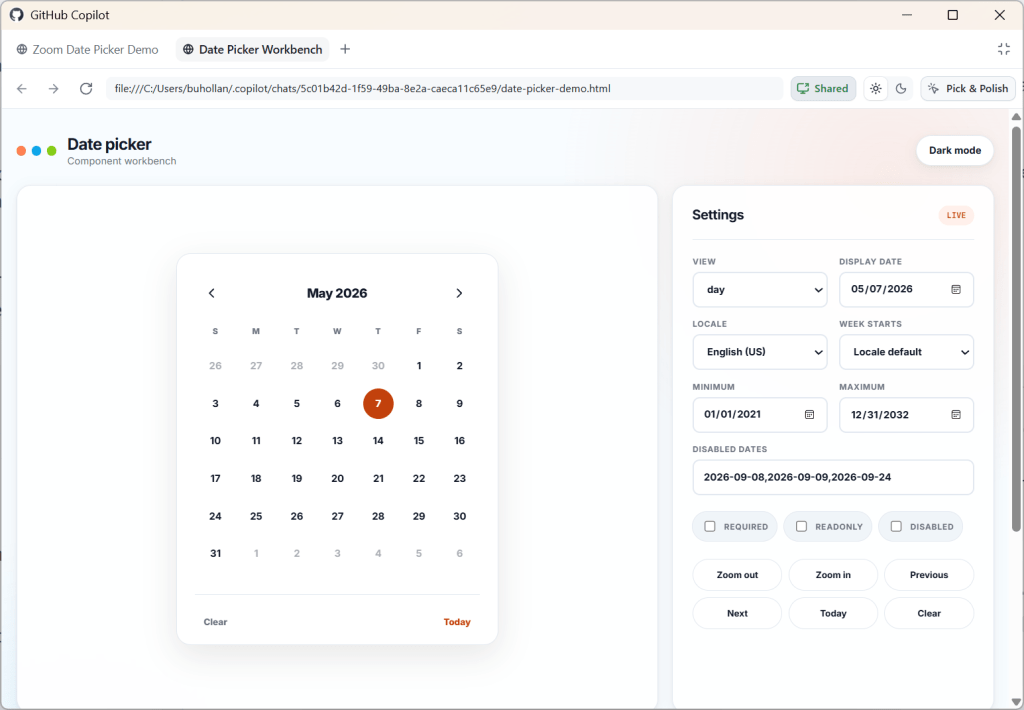
For instance, here’s the date picker that GitHub Copilot gave me.
Already I can see it has some issues:
Animations are inconsistent
Text is unreadable when hovering over a selected date because of color contrast
It doesn’t need to say “12 YEARS” at the top.
When I click “Today”, it doesn’t take me to the day if I’m in the month or year view.
Also, I don’t love the design. It looks a little too much like it was created by AI - because it was!
So here we’re just in follow-up mode. I’m going to use a CSS framework I created called Postrboard. I add it as a skill that just points to the CSS and tells the agent how to use it. You can feel free to install it yourself if you’d like to use it, or you can pick any other CSS framework out there that you like. Giving the model some design guidance is quite helpful, and often a CSS framework is all you need.
ok - we don't need a landing page here - just the component, output and settings panel in a minimal setting. Use the /postboard skill for the design and colors.
For the date picker, when I click on the day, it tries to zoom in, but can’t because there is nothing to zoom to. There should be no zoom there.
It doesn’t need to say “Zoom Out” at the top
When I mouse over a month or year that contains the selected day, I cannot read the hover text.
When I click “Today” it should take me to that day view, even if I’m on the month or the year.
The months don’t need numbers under them and they don’t need to be in boxes
Same goes for years. And it doesn’t need to say “12 years” at the top.”
Notice how conversational this is. Don’t overthink it. When you’re fixing a bunch of small things like this, just give it to the model. If you’ve got the context, you’ve got the prompt.
The most important thing is not to settle for AI output that is “good enough.” Insist on quality. Be ruthless about it. That part is still your responsibility, and knowing what a quality result is from something that isn’t is the value that you bring. No AI will ever replace your human touch and creativity.
Here’s what my final date picker looks like. Scroll to the end of this post to see it in action.
7. Rubber duck the result
After you’ve iterated and are happy with what you’ve created, it’s time to do a final review.
Request a Rubber Duck review from GitHub Copilot. You can do this just by asking for it:
Perform a rubber duck review on this date picker component implementation
In a Rubber Duck review, GitHub Copilot will request a review from a model of a different AI family. For instance, since I was using GPT 5.6 Terra, it requested a review from Sonnet. Different models were trained on different data, so they have different blind spots. A Rubber Duck review helps identify potential issues that might be missed by a single model.
Note that you can use this at any point in this workflow. You can rubber duck prototypes. You can rubber duck plans. It all just depends on if you want a second AI review on something.
And if you want to take this a step further, you can combine rubber duck with Autopilot to get the models to work together in a loop to improve the final result.
/autopilot rubber duck this date picker implementation. When you have the result, review it carefully and make any necessary adjustments. Repeat the rubber duck review until both you and the reviewing model agree that the only items that remain have diminishing returns.
After this step, you will have an even more refined result than before and will have likely identified many extra edge cases. This step does cost more tokens, but you are really battle-hardening the code. Think of it as an investment in your future self who won’t have to deal with these issues because you caught them now.
8. Profit
At this point, you’re ready to stage and commit, or move on to the next feature you want to add along with this pull request.
I’d recommend starting a new chat session for anything you do next that doesn’t have to do with this date picker. You can think of chat sessions as being topical; if you start to diverge too much from the main topic, it’s probably time for a new session.
Here’s the final result from my workflow building the date picker for this post.
I realize that this is a bit of a contrived example, but can we all just pause for a moment and marvel at what we’re able to pull off with AI now? Building a date picker used to be one of the hardest things you could try to do. Just ask any of the heroes out there who have built them.
Things don’t have to be complicated
This simple workflow will be enough for most people. The simplicity also helps you multitask. It’s easier to reason about what agent is in what state and what you were doing last when you keep things simple. Your context window is limited too.
There is so much happening in the AI space right now. There is no upper limit on the things that you can build and experiment with. You can add MCP servers, skills, instructions, and custom agents. You can set up workflows and loops, create agents that prompt agents, and stand up entire virtual dev teams.
But keep in mind that nobody really knows what they are doing right now. We’re all figuring this out as we go. A lot of what is today’s magical incantation for AI will be tomorrow’s anti-pattern.
Just focus on getting a repeatable, high-quality result in the simplest way that you can. Learn the harness and you’ll be just fine. | ## A practical GitHub Copilot workflow for prototyping, planning, implementing, and reviewing software - without chasing every new AI tool.
By @burkeholland
If you’re feeling overwhelmed by AI right now, you’re not alone.
Every day it seems there is a new tool, new MCP, new model, new skill, new workflow, new feature, new social post that is some form of “Hey look! I have completely figured out AI with this one weird prompt.”
I…don’t believe you.
I work with AI every single day, and what I’m finding is that less is way more. It’s not about what I install or configure or trick the agent into doing that makes any real difference. That stuff is interesting, but at the end of the day it feels like gimmicks.
I see the biggest gains in my productivity from how I use the harness and how well I understand it.
So in this post, I’m sharing you a simple workflow that you can use to drastically improve your effectiveness with AI just by using existing features of [GitHub Copilot](https://github.com/features/copilot). No weird prompts. No skill everyone else seems to know about. Just the harness. The harness is all you need - mostly.
## Disclaimers
I’m using the term “harness” interchangeably with “GitHub Copilot.” The point of this post is to keep things simple, so just know that GitHub Copilot is an agent harness.
I don’t mean to insinuate that you won’t ever need any skills or MCPs or instructions or custom agents, etc. In fact, those things will become quite important as you progress and need to define complex workflows and automate things for your teams. In fact, I use a few throughout this blog post!
What I am pointing out here is that you do not need any of those things to be highly successful with AI.
Also, there is a lot of slop out there. If you don’t believe that, ask the agent to create a skill to do anything at all. It will happily oblige. Whether or not that generated skill actually works, it can be easily published to any number of skill or MCP registries.
## 1\. Pick a tool, any tool
This is an obvious one, right? Pick a tool! It’s so easy!
But even within the GitHub Copilot family, there are a lot of options. These include the [CLI](https://docs.github.com/copilot/github-copilot-in-the-cli), the new [GitHub Copilot app](https://docs.github.com/copilot/concepts/agents/github-copilot-app), [VS Code](https://code.visualstudio.com/), [Visual Studio](https://visualstudio.microsoft.com/), and [JetBrains](https://www.jetbrains.com/), just to name a few.
The good news is that these experiences are increasingly being centralized on the same harness. The details can differ by tool, but the core workflow is consistent. Learn the harness once, use it everywhere.
That said, I do believe that learning the harness is key, and the best way to learn it is to be as close to it as possible. So if you are just starting out, I’d recommend beginning with the GitHub Copilot CLI. It’s a terminal interface, which means it’s just text. There isn’t much UI to learn. You enter a prompt. The agent does things. But the interaction is more direct, immediate, and, frankly, very satisfying.
For this demonstration, I’ll be using the new [GitHub Copilot app](https://gh.io/app). But the harness that app uses is the exact same thing you’ll be using if you are using the GitHub Copilot CLI, Visual Studio Code and many other places you can find GitHub Copilot.
## 2\. Turn on YOLO mode
YOLO mode is also known as “[Allow All](https://docs.github.com/en/copilot/how-tos/copilot-cli/use-copilot-cli/allowing-tools).” This lets the agent execute any command without asking permission. This can vary depending on the tool you are using, but for most it is simply an /allow-all command in the chat. Otherwise, the agent is going to stop and wait for your approval every single time it needs to do some work.
Agents need autonomy for you to see an increase in productivity. If you have to approve everything the agent does, you might as well just do it yourself. Besides, that’s a miserable user experience. Nobody wants to be relegated to sitting at a desk pressing the “Approve” button all day. And pressing “Approve” over and over just trains you not to read what you are being asked to approve, which defeats the purpose.
You want to be safe with agents, though. [Bad things happen to good people](https://x.com/mattshumer_/status/2075666403596612010). When using YOLO mode, you don’t want to run the agent on your local machine. This is especially true when you are using them at work - data is private on your organization’s systems, and mistakes can be costly.
Fortunately there are a bunch of options for running agents in sandboxes. An easy one to get started with is [GitHub Codespaces](https://docs.github.com/codespaces/overview) or [development containers](https://containers.dev/).
## 3\. Start with a prototype
One of the most magical things about AI is that you can easily prototype anything and everything up front. Historically, this was not the case. Prototyping was a full phase of a project, and were often a luxury. Now, you can make one with a prompt.
Let’s look at a few examples.
Let’s say we want to build a date picker web component. That seems straightforward, but it’s actually quite complex. Think of all the different things you might want to do with it.
- How do you navigate within the component?
- What does the selected date look like?
- What does a selected range look like?
- How does the user navigate between days, months, and years?
Start with a simple prototype and get several variations. I usually start with something like this:
> Give me 20 mocks for a date picker web component. Put them all in an HTML file so I can compare.

In this case, the AI generated a bunch of different layouts, but one of them is a mock where it starts with the year view. That’s interesting. I would like my date picker to enable the user to zoom out to the year, then into the month, and finally to the day. These are the kinds of things you don’t consider until you see them.
As humans, we process sensory-rich models like images, shapes, and tangible layouts much faster than dense text. Creating low-effort prototypes early on helps make complex concepts immediately intuitive.
And this applies to non-visual tasks as well.
For instance, if I want to add a new API endpoint, I’ll still create a visual prototype to understand the requirements and constraints before diving into the implementation.
> Create a visual mockup of the API for this project. Add five options for how we could handle a new API endpoint that allows the user to download their analytics data.
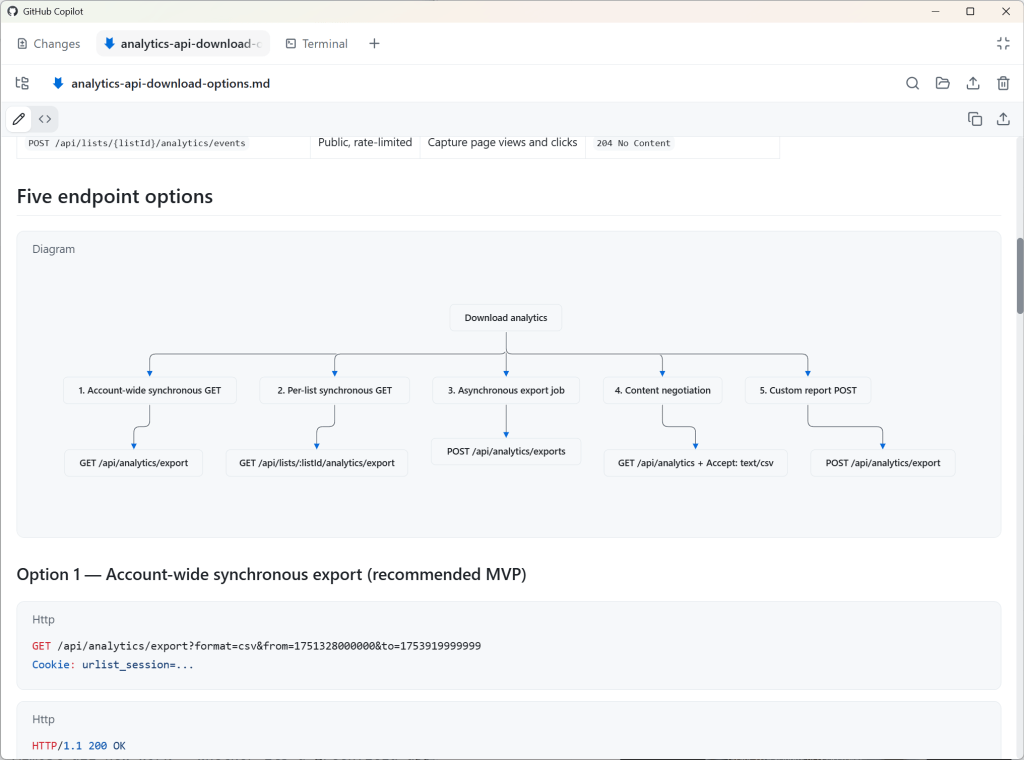
Since the GitHub Copilot app supports [Mermaid diagrams](https://docs.github.com/copilot/tutorials/copilot-cookbook/communicate-effectively/creating-diagrams), the agent renders this as Markdown, mapping out five different ways we could implement this API endpoint.
When working with agents, it’s easy to forget that everything is nuanced. Prototyping helps uncover the nuances up front, so you avoid spending valuable time and tokens on rework.
I recommend using a medium-sized model, such as GPT 5.6 Terra or Claude Sonnet, on medium reasoning for most work. I also recommend you stick with whatever model you choose here for the duration of this particular feature, bug, or enhancement. Prompt caching will save you tokens. As long as you don’t switch to a different model or reasoning level, your previous chats remain cached with the model, giving you a discount on future requests.
## 4\. Plan methodically
Now that you know what you actually want versus what you initially thought you wanted, it’s time to plan out the implementation.
Switch to plan mode in GitHub Copilot without starting a new session.
> /plan Build a date picker web component. I want the user to be able to zoom in and out of years, months, and days.
That’s a pretty vague prompt, and you’ll likely have more context for the model than I do here, but this is just a demonstration. If you don’t have more context, it’s OK. That’s exactly what this step is for.
In theory, you can get a model to one-shot anything if you compose the perfect prompt with the perfect context in the perfect order. In theory.
But none of us can do that. Planning helps you get closer to that ideal, though, by asking all of the questions that you would need to answer yourself along the way if you were to build this out by hand:
- Can the start and end date be the same?
- Are partial selections valid?
- Should users be able to clear the date?
- Should “today” always be a visible option?
- Is manual entry allowed?
- What format is the date stored in?
- Should pasting in dates be allowed?
The list goes on and on. You cannot possibly think of all of these edge cases, but the model can help you identify many of them.
You can make plan mode even more aggressive in the sheer number of questions and edge cases it asks about by installing the [“grill-me”](https://www.skills.sh/mattpocock/skills/grill-me) skill from Matt Pocock.
> /plan /grill-me Build a date picker web component. I want the user to be able to zoom in and out of years, months, and days.
This planning step is critical. The point is not for you to just accept every suggestion from the AI. If you do that, you are negating the value of this planning process. The point is for you to deeply engage with the problem and guide the model. This is where your expertise comes into play.
You can also ask the model questions back. In the screenshot below, it asks me about “non-contiguous dates.” I’m pretty sure I know what the model means here, but I’m going to ask for clarification so we’re on the same page.

The planning process will keep going even if you interrupt to ask clarifying questions, etc.
## 5\. Implement with Autopilot
Once the plan is finished, GitHub Copilot will likely prompt you to switch to [Autopilot](https://docs.github.com/copilot/concepts/agents/copilot-cli/autopilot) and start implementing the plan.
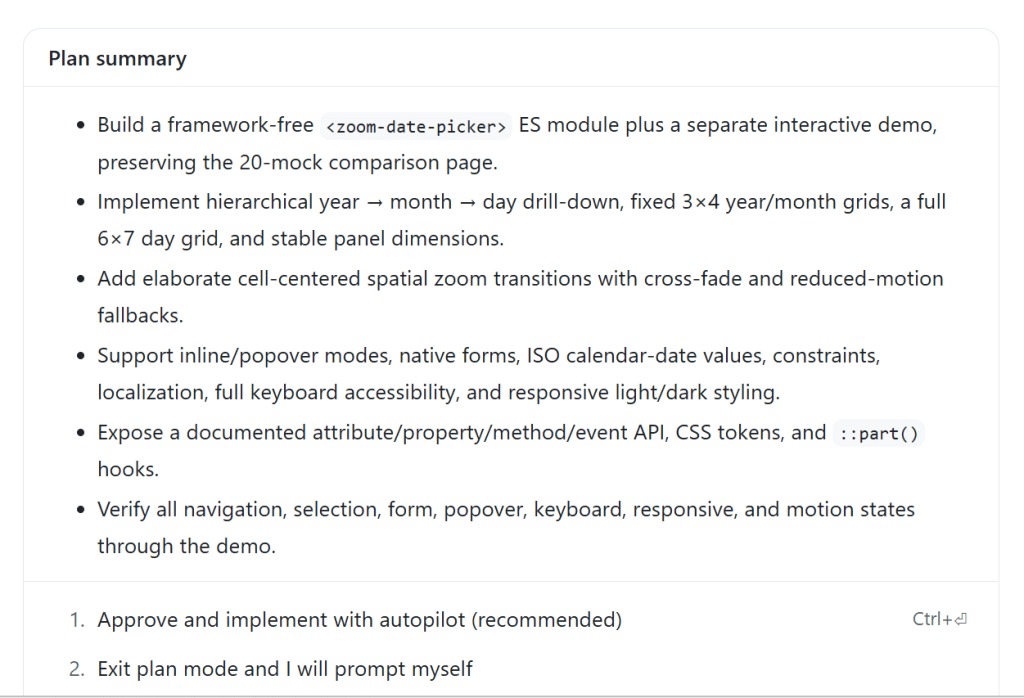
Autopilot is a built-in loop. It forces the model to continue working by ensuring that it has actually done what it said it would do - which in this case is completing every item in the plan.
GitHub Copilot will automatically act as an orchestrator during this phase. If it needs to read files in the codebase, it will use the “Explore” subagent with a small model. If it deems an action relatively complex, it will likely choose the “General Purpose” subagent with a larger model. While you can get fine-grained control over orchestration in GitHub Copilot with [custom agents](https://docs.github.com/copilot/how-tos/copilot-cli/customize-copilot/create-custom-agents-for-cli) and [instructions](https://docs.github.com/copilot/how-tos/copilot-cli/customize-copilot/add-custom-instructions), you don’t need to do anything special to get the advantages of subagents and multimodel workflows. This works out of the box, even if you did not know that any of these things existed.
## 6\. Human review and iteration
This is where you get your dopamine hit. You get to see what the AI has created.
But it’s likely that you won’t get exactly what you wanted. That’s normal and expected. The model cannot read your mind, and it is error-prone. Iterate with the model until you get what you actually want. Whether that’s just code or an improved UI, this is the part where your taste will decide the quality of the final product.
For instance, here’s the date picker that GitHub Copilot gave me.
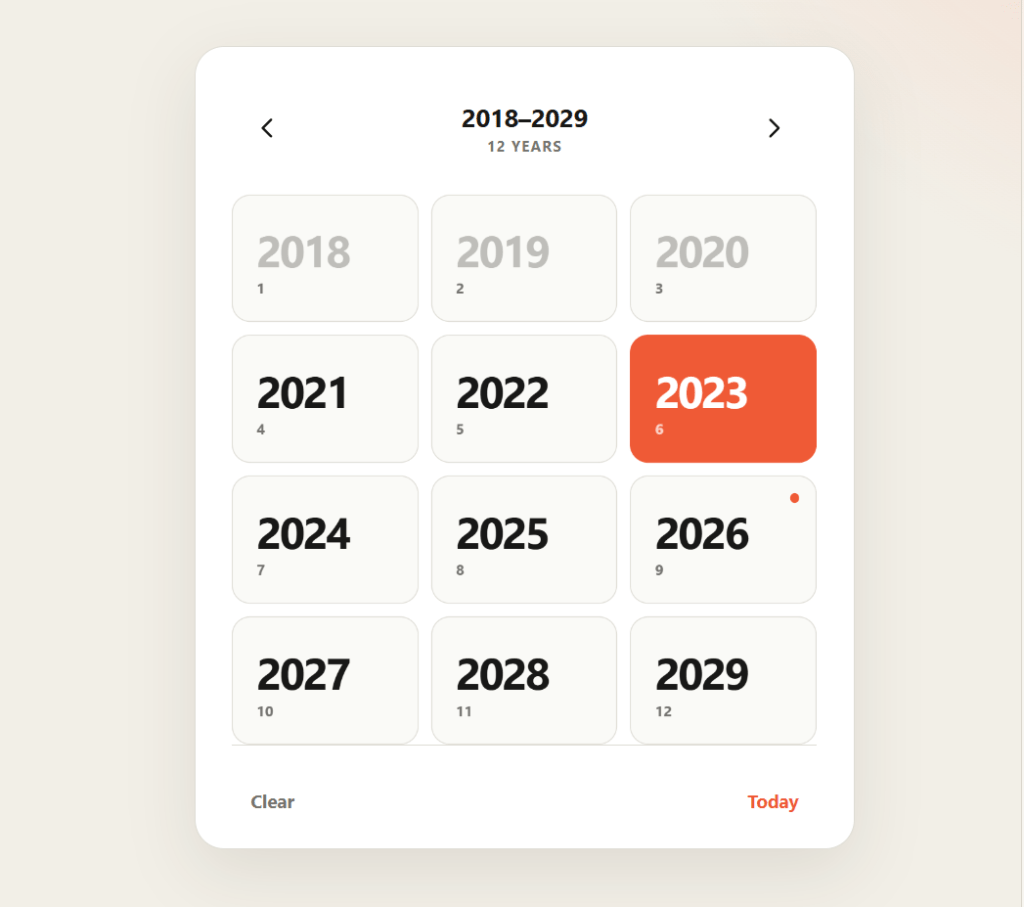
Already I can see it has some issues:
- Animations are inconsistent
- Text is unreadable when hovering over a selected date because of color contrast
- It doesn’t need to say “12 YEARS” at the top.
- When I click “Today”, it doesn’t take me to the day if I’m in the month or year view.
Also, I don’t *love* the design. It looks a little too much like it was created by AI - because it was!
So here we’re just in follow-up mode. I’m going to use a CSS framework I created called [Postrboard](https://burkeholland.github.io/postrboard-design). I add it as a skill that just points to the CSS and tells the agent how to use it. You can feel free to install it yourself if you’d like to use it, or you can pick any other CSS framework out there that you like. Giving the model some design guidance is quite helpful, and often a CSS framework is all you need.
> ok - we don't need a landing page here - just the component, output and settings panel in a minimal setting. Use the /postboard skill for the design and colors.
> For the date picker, when I click on the day, it tries to zoom in, but can’t because there is nothing to zoom to. There should be no zoom there.
> It doesn’t need to say “Zoom Out” at the top
> When I mouse over a month or year that contains the selected day, I cannot read the hover text.
> When I click “Today” it should take me to that day view, even if I’m on the month or the year.
> The months don’t need numbers under them and they don’t need to be in boxes
> Same goes for years. And it doesn’t need to say “12 years” at the top.”
Notice how conversational this is. Don’t overthink it. When you’re fixing a bunch of small things like this, just give it to the model. If you’ve got the context, you’ve got the prompt.
The most important thing is not to settle for AI output that is “good enough.” Insist on quality. Be ruthless about it. That part is still your responsibility, and knowing what a quality result is from something that isn’t is the value that you bring. No AI will ever replace your human touch and creativity.
Here’s what my final date picker looks like. Scroll to the end of this post to see it in action.
## 7\. Rubber duck the result
After you’ve iterated and are happy with what you’ve created, it’s time to do a final review.
Request a [Rubber Duck review](https://docs.github.com/en/copilot/concepts/agents/copilot-cli/rubber-duck) from GitHub Copilot. You can do this just by asking for it:
> Perform a rubber duck review on this date picker component implementation
In a Rubber Duck review, GitHub Copilot will request a review from a model of a different AI family. For instance, since I was using GPT 5.6 Terra, it requested a review from Sonnet. Different models were trained on different data, so they have different blind spots. A Rubber Duck review helps identify potential issues that might be missed by a single model.
Note that you can use this at any point in this workflow. You can rubber duck prototypes. You can rubber duck plans. It all just depends on if you want a second AI review on something.
And if you want to take this a step further, you can combine rubber duck with Autopilot to get the models to work together in a loop to improve the final result.
> /autopilot rubber duck this date picker implementation. When you have the result, review it carefully and make any necessary adjustments. Repeat the rubber duck review until both you and the reviewing model agree that the only items that remain have diminishing returns.
After this step, you will have an even more refined result than before and will have likely identified many extra edge cases. This step does cost more tokens, but you are really battle-hardening the code. Think of it as an investment in your future self who won’t have to deal with these issues because you caught them now.
## 8\. Profit
At this point, you’re ready to stage and commit, or move on to the next feature you want to add along with this pull request.
I’d recommend starting a new chat session for anything you do next that doesn’t have to do with this date picker. You can think of chat sessions as being topical; if you start to diverge too much from the main topic, it’s probably time for a new session.
Here’s the final result from my workflow building the date picker for this post.
I realize that this is a bit of a contrived example, but can we all just pause for a moment and marvel at what we’re able to pull off with AI now? Building a date picker used to be one of the hardest things you could try to do. Just ask any of the heroes out there who have built them.
## Things don’t have to be complicated
This simple workflow will be enough for most people. The simplicity also helps you multitask. It’s easier to reason about what agent is in what state and what you were doing last when you keep things simple. Your context window is limited too.
There is so much happening in the AI space right now. There is no upper limit on the things that you can build and experiment with. You can add MCP servers, skills, instructions, and custom agents. You can set up workflows and loops, create agents that prompt agents, and stand up entire virtual dev teams.
But keep in mind that nobody really knows what they are doing right now. We’re all figuring this out as we go. A lot of what is today’s magical incantation for AI will be tomorrow’s anti-pattern.
Just focus on getting a repeatable, high-quality result in the simplest way that you can. Learn the harness and you’ll be just fine. | 2026-07-28T20:28:35Z | 538,450 | 1,536 | 195 | 44 | 24 | 3,023 | 13334762 | |||||
4 | 2036767732096766335 | 2036729163789516800 | 縦長画像トリミング廃止と収益分配ルール改定騒動 | 今日はXに関する個人的に大きなニュースが2つです。 まったく別の話題のように見えますが
わたしは2つの話題に共通項を見出しています。 現時点では2つ目は「案」と捉える方が良さそうです。 これまではアスペクト比が「3:4」よりも縦長の画像は、タイムライン上では自動的に上下がトリミングされて、全表示されませんでした。 これが「画像1枚のときに限り」、タイムライン上でもトリミングされず、全表示されるよう | 今日はXに関する個人的に大きなニュースが2つです。
1つ目はAIイラスト界隈にとって
2つ目は収益界隈にとって
まったく別の話題のように見えますが
わたしは2つの話題に共通項を見出しています。
現時点では2つ目は「案」と捉える方が良さそうです。
💡先に結論
1.縦長画像がトリミングされなくなる
画像1枚ポストはトリミングされなくなった
縦長画像もタイムラインで全表示される
エンゲージメントベイト対策の可能性(推測)
縦長画像ポストがメインのアカウントは今後はインプレッションが低下する可能性(推測)
2.収益配分プログラムの収益算定ルール改定(未確定)
ホーム地域からのインプレッションに重み付け
ホーム地域外からのインプレッションには収益が発生しない
ホーム地域外へのリーチがメインのアカウントは収益が減少
ホーム地域内へのリーチがメインのアカウントは収益が増加?
1.縦長画像がトリミングされなくなる
これまではアスペクト比が「3:4」よりも縦長の画像は、タイムライン上では自動的に上下がトリミングされて、全表示されませんでした。
これが「画像1枚のときに限り」、タイムライン上でもトリミングされず、全表示されるようになりました。
◆背景
最初のアナウンスはこちらのポストでした。
Xは、1枚の画像をアップロードする際のトリミングをまもなく停止します。
https://x.com/Iorel_X/status/2036155983873937516
わたしも投稿直後にこのポストに気付いていたのですが、「ふーん」くらいにしか思わなかったんですよね。
ちなみに、lorel氏は、X(旧Twitter)の新機能リーク・更新情報を専門に発信しているアカウントです。
この件に関して
縦長画像がトリミングされないので
タイムラインでも大きく表示されて良いね!
程度の印象しか当初は持ちませんでしたし、他のX運用アカウントも同様だったのですが、時間が経ってからふと「あること」に気付いたのでわたしもポストしました。
単純にタイムライン上での見かけの話ではなくて、「エンゲージメントベイト対策の一環ではないか?」ということに気付きました。
というのも、ポストでも触れている通り、毎度おなじみXプロダクトマネージャーNikita氏が「タップ誘導するポストをエンゲージメントベイトと見做している」という背景があります。
この件についてはこちらの記事に詳しく経緯をまとめています。
Nikita氏が触れているのは、主に複数画像で「タップしてサプライズを見る」という構造のポストについてでしたが、わたしはこれを「縦長画像にすることで主要部分を隠してタップ誘導するポスト」も該当すると考えました。
そういうポスト、ありますよね?
二次創作・センシティブ系のアカウントに多い印象があります。
そして、それは数万~十数万フォロワー規模の大型アカウントに多い。
◆試してみた
新しいことや変化があると試してみたくなる性分なので、縦長画像がどのように見えるのか実際に試してみました。
「3194 × 9856」という縦長画像です。
タイムライン上の表示は、ブラウザ版では「3:4」にトリミングされて上下が見切れています。
iPhoneからタイムライン(プロフィール)でどのように表示されているか見てみました。
全表示されてる!
こうなると、どこまで縦長に対応するのか試してみたくなります。
「1856 × 9856」と、さらに長い縦長画像です。
ほっそwww
どうやらタイムライン上では、「3:4」表示したときの縦寸法を基準にしているようなので、長くなればなるほど細長く表示されるようです。
こうなると、縦長画像は単純に縮小表示されるだけなのでメリットがないですね。
あ、だから「大きくして見よう」という動機にはなりますね。
メディアタップ・拡大表示は狙えるか…。
フォロワーさんから「漫画を発信している人にとってはメリットがあるのでは」というご意見をいただきました。
ので、これも早速試してみました。
ブラウザ版ではやはり「3:4」でトリミングされますが、こちらもタイムラインでは全表示されます。
タイムラインから全体を読めるのはとても良いですね!
4コマ漫画の場合は、アスペクト比の都合上、縮小表示されるので文字サイズに注意が必要になりそうです。
漫画の場合は、オチまでタイムラインで見えてしまうので、メディアのエンゲージメントは減るかもしれません(結果的にインプレッションも減少)。
ですが、しっかり読もうと思えば詳細クリックや拡大表示するので問題ないですね。エンゲージメント的にもその方がメリットありますし。
結局は、内容次第ということになりそうです。
◆今回のアップデートで考えられること(推測)
「縦長画像にすることで主要部分を隠してタップ誘導するポスト」は、今後はインプレッションが低下する可能性があると考えています。
なぜかというと、タイムラインで全部見えているので、これまでのようにユーザーが隠れている部分を確認するためにタップする必要が無くなるためです。
現在のXのアルゴリズムは、ポストに対するユーザーの各種アクションをもとに類似ポストのスコアリングが行われ、おすすめタイムラインでの表示順位が決まります。
これまで縦長画像のインプレッションが高かったケースでは、隠れている部分を見ようとすることで、詳細クリック、メディアクリック、拡大表示といった複数のポジティブなアクションが発生し、それらがスコアにプラスに働いた結果、おすすめタイムラインで上位表示されていた可能性があります。
また、同様の構造を持つポストを投稿した場合、過去の反応履歴をもとに確率予測が行われ、上位表示されやすくなっていた結果、インプレッションを獲得していたと考えられます。
しかし、タイムライン上で画像全体が見えるようになると、詳細クリックやメディアクリック、拡大表示は従来より減少する可能性があります。
その結果、ユーザーから得られるポジティブな反応が減り、スコアがこれまでより低下することで、おすすめタイムラインで上位表示される確率も下がり、最終的にインプレッションが低下する可能性があります。
あくまでもわたしの推測ですが、先のNikita氏の発言・見解から、Xはトリッキーな手法によるインプレッションの獲得を阻止しようとしており、今回のアップデートもその一環ではないかと考えました。
◆まとめ
画像1枚ポストはトリミングされなくなった
縦長画像もタイムラインで全表示される
エンゲージメントベイト対策の可能性(推測)
縦長画像ポストがメインのアカウントは今後はインプレッションが低下する可能性(推測)
2.収益配分プログラムの収益算定ルール改定の可能性
現在の収益算定は「おすすめタイムラインからの認証済みユーザーによるインプレッション」を基準にしています。
いまだに「エンゲージメント」や「広告閲覧」とか言っている人がいますが、大間違いです。いつの話をしているんです?
更に言えば、インプレッションは上記の通り「おすすめタイムライン」に限るので、通知・リスト・フォロー中などから発生したインプレッションは算定対象には含まれません。
◆背景
この収益算定ルールに関して、収益化勢にとっては衝撃的なニュースがNikita氏からアナウンスされました。
木曜日から、Xに望ましいコンテンツをより良く報酬するよう、収益分配インセンティブを更新します:
あなたのホーム地域からのインプレッションにより大きな重み付けを与えます—あなたの国や近隣諸国の人々、そしてあなたの言語を話す人々に共鳴するコンテンツを奨励するためです。
アメリカの政治に関する皆さんの意見をありがたく思いますが、これにより米国や日本のアカウントの注目を操作する行為を抑制し、代わりにプラットフォーム上で多様な会話を促進することを期待しています。
クリエイターの皆さんに、地元でオーディエンスを構築し始めることをお勧めします。世界中のすべての地域の人々にとって関連性のある投稿があれば、Xははるかに豊かなコミュニティになるでしょう。
https://x.com/nikitabier/status/2036603028619534564
インプレッション基準というのは変わらないのですが
ホーム地域からのインプレッションに重み付けする
という発表です。
ざっくり言えば、日本のユーザーは日本国内からのインプレッションに重み付けして収益算定をする、という話です。
正確に言うと、「ホーム地域」というのは「日本在住=日本だけ」というものではなく、「自国+近隣国+同じ言語圏」とかなり広めに定義されているみたいです。
とはいえ、たとえば米国は明確に地域外になりますよね。
◆目的は?(推測)
Nikita氏は「あなたの国や近隣諸国の人々、そしてあなたの言語を話す人々に共鳴するコンテンツを奨励するため」と言っていますが、これは表向きで、真の目的はインプレゾンビ駆逐にあると思っています。
というのも、続いて「アメリカの政治に関する皆さんの意見をありがたく思いますが、米国や日本のアカウントの注目を操作する行為を抑制」と書いていますよね。
これがどういうことを指すのかを、Nikita氏のポストへのリプライとそのやり取りからわたしは以下を推測しています。
米国以外(たとえばナイジェリア)のユーザーが、米国の政治に関する話題などを投稿して、他国(ホーム地域外)の注目(インプレッション)を稼ぐような行為を抑制するため。
つまり、インプレゾンビを抑制するのが目的と考えます。
実際の収益算定がどうなるのか?
Nikita氏は「ホーム地域からのインプレッションにより大きな重み付けを与えます」と言っているので、文面通りならば「ホーム地域からのインプレッションにはより多くの収益を与える」と読めます。
この場合、「ホーム地域外からのインプレッションにも収益が発生する」、と解釈できますよね。
たとえば:
全地域でインプレッションにかかる重みを一律に「1」とする。
ホーム地域からの場合は重みを「2」とする。
→ ホーム地域からのインプレッションに、より大きな重み付け
この場合は、ホーム地域外からのインプレッションに対する重み付けには影響しないので、純粋にホーム地域のインプレッション分だけ収益が増えることになりますよね。
Nikita氏の文面を素直に解釈するとこうなります。
が、
この場合では、同じくNikita氏発言の「注目を操作する行為を抑制」と矛盾しますよね?
結局、相対的に重み付けが大きくなるだけならば、収益が増えることはあっても減ることは無いので、インプレゾンビ対策にはならないです。
ということは:
ホーム地域のインプレッションにかかる重みを「2」とする。
ホーム地域外からの場合は重みを「0.5」あるいは「0」とする。
→ 結果的にホーム地域からのインプレッションに、より大きな重み付け
「注目を操作する行為を抑制」というならば、ホーム地域外の場合は重みが「0」にするのが普通ですよね。つまり掛率が「0」なので収益は発生しない。
そうなると、ホーム地域の重み付けが大きくなるとはいうものの、実際は「1」のまま、地域外と比べると相対的に「大きくなる」というのも成り立ちます。
こうなるとケースによっては、全ユーザーの収益がこれまでより減る可能性もあるのでは?
日本在住のユーザーで、日本向けに発信していて、オーディエンスは現に日本国内からが多く、海外は僅か、よって「ヤッター!収益が増える!」
と思いきや、そうはならないことも考えられますよね。
重みが無くて全地域のインプレッションが収益対象となっていた時の方が収益が多かった、ということはあり得るのでは?
ということを書いていたら、Nikita氏から答えが出ました。
先のNikita氏のポストに対するポルトガルのユーザーからの陳情。
一部の国にはほとんどユーザーがいません。
自分の国を超えた広いリーチを持つことを理由に、人々が罰せられるべきではないと思います。
(敬意を込めて。どうか私をBANしないでください)
https://x.com/Antunes1/status/2036609114025886099
そりゃそうですよね。
Xユーザーが少ない国も当然あるわけです。
最後の一文が…。
これに対するNikita氏の回答です。
わたしの疑問に対する回答にもなります。
ポルトガルでの生活についての皆さんの考えをお聞かせいただければ嬉しいです。きっと、そこで過ごす毎日の経験について、素晴らしいエピソードがたくさんあることでしょう。
もちろん、アメリカの政治について引き続き意見を述べていただくのは大歓迎です。ただ、そうした内容のために海外にお金を送ることはありません。
https://x.com/nikitabier/status/2036618402660602274
「ポルトガルのこと書いてりゃいーじゃん」
「アメリカのこと書いてもいいけど金は払わんよ」
ということだそうです。
無慈悲。
ANTUNES氏のおかげで疑問の答えが出ました。
ホーム地域外からのインプレッションにはそもそも収益が発生しない。
ということですね。
となると、要は収益対象となるインプレッションをホーム地域に限ることになるので、重みがどうとか言うのは建前の話で、やっぱり全体としては収益が減りますよね。
これを書いている最中に進展がありました。
ユーザーのポストです。
私はフランス在住ですが、私の視聴者の43%はアメリカ人です。
私たち多くの人が同じ状況にあることを知っています。より広い視聴者に届けるために、私のすべての投稿は国際語である英語で書いています。
問題を引き起こす人々は罰せられるかもしれませんが、この変更により私たちの収益が大幅に減少する一方で、悪意なく国際語を使用している多くのアカウントも罰せられてしまいます。
Xは、動画や新しい高品質なコンテンツが優先されると言っていますが、この変更は逆に、私たちの収益を劇的に減少させることになります。
この決定を覆す方法は何か、ありますか?🥺
https://x.com/dvorahfr/status/2036666985468043580
もっともな意見です。
これに対してイーロンさんが直々にリプライしています。
これ以上進めるのを一時停止し、さらなる検討を行います。
https://x.com/elonmusk/status/2036685311179477401
イーロンさんがストップをかけました。
また、Nikita氏は先ほどのANTUNES氏をあの後「凍結した」そうです。
さすがにやりすぎですよね。
ニキータ・ビアは、クリエイターペイアウトがこれからはユーザーの所在地に影響されるようになると述べています。
しかし、私には個人的に一切支払われないと言われました:「私たちは海外にお金を送りません。」
なぜ普通のユーザーがこんなふうに標的にされるんでしょう?
この変更は多くの問題を引き起こすと思います:
- 海外在住の米国市民はどうなる? (多くがフルタイムのXクリエイターです)
- 正当な国際クリエイターはどうなる?
- ユーザー基盤の小さい国からのユーザー? (バチカン、800人;アンドラ、8万人など)
- 国際的なフルタイムXクリエイターはどうなる?
私のアカウントのようなものが、月間1億インプレッション以上を提供しているのに全く支払われないのはなぜ? プロダクト責任者が私を嫌いだから?
@elonmusk はこれを調べてほしいと思います。
「第三世界国からの外国干渉」に対処するより賢い方法があります。
ニキータについて敬意を持ってコメントした数分後にサスペンドされ、その後イーロン・マスク自身によってアンバンされました。また起こらないことを願います。
ただ私の意見です、敬意を込めて。
https://x.com/Antunes1/status/2036644863412777174?s=20
Nikita氏が凍結して、イーロンさんが解除したようです。
Nikita氏…。
◆今回のルール改定が実施された場合に考えられること(推測)
単純に、ホーム地域外へのリーチがメインだった人は収益が減ると予想します。
ホーム地域へのリーチがメインだった人は増えるかというと、前述の通り現時点では不透明だと思っています。
重みが絶対的に大きくなるならば、値によっては大きく増えるでしょうけど、もしもこれが相対的である場合や値が小さいならば、海外分がゼロになるのでほとんどの場合で収益は減るのではないでしょうか。
結局は、どちらの該当者も収益は減る、ということがあり得ると考えます。
もしも改定が実施された場合、Xクリエイター収益分配への影響はどうなるでしょう。
ちなみに、わたしのこのスパンの現在までのオーディエンスはこちらです。
項目は「インプレッション」です。
約85%が「Japan」、つまりホーム地域からですね。
インプレッション自体が前回スパンよりも少ないので、そもそも収益が減少することを予想していますが…。
どうなるでしょう。
AIイラスト界隈では、海外ユーザーへのリーチをメインとして活動している人もいると思います。わたしも一部のモチーフは海外を意識しています。
収益化している場合、もしもNikita氏がアナウンスしている内容で実施されると、今後は収益が減ることは間違いないと思います。
海外向けの方がパイが大きいため、フォロワー数もインプレッション数も伸びるので、数万~十数万フォロワー規模の大型アカウントが多い印象です。
奇しくも前述した縦長画像ポストがメインのアカウントと重なりますね。
最悪なケース想定:
縦長画像が全表示になったことでインプレッション減少
海外からの収益ゼロ
国内向けに方針転換すると海外フォロワー・インプレッション減少
フォロワー減、インプレッション減、収益減、というトリプルパンチもあり得そうです。
◆まとめ
ホーム地域からのインプレッションに重み付け
ホーム地域外からのインプレッションには収益が発生しない
ホーム地域外へのリーチがメインのアカウントは収益が減少
ホーム地域内へのリーチがメインのアカウントは収益が増加?
📝まとめ
個人的に大きな話題が2つ続きました。
1つ目はAIイラスト界隈にとって、2つ目は収益界隈にとって。
といっても1つ目の方で影響受ける人は界隈でも一部と思われます。少なくともわたしのおすすめタイムラインに表示される人は該当し無さそう。
2つ目はX全体にかかることなので、影響を受ける人も多そうですね。
わたしもそうですし。
冒頭に書いた2つの話題の共通項ですが
それは「インプレゾンビ対策」だと思います。
Nikita氏のポストを追っているとわかりますが、とにかくX(Nikita氏)は不正アカウントを撲滅したいのだと思います。
不正をしているユーザーが何かアルゴリズムや収益に関連するポストをすると、出張って言って直々にBANを告げるくらいですからね。
睨まれないように気を付けないと。
これもあって、わたしはX公式ポリシーを遵守している、というのもあります。
いつ目を付けられるかわからないですよ?
グローバルに活動したい場合に、ホーム地域以外を対象としてコンテンツを展開することは何も不自然なことではないですよね。Xだって広く交流を推奨しているはずですし。
海外では不満が爆発していますが、インプレゾンビ対策としては有効だとわたしは思います。
しかしながら、インプレゾンビの排除を思うがあまり、ユーザーの都合や実情に合わないことを強行しようとした感じは否めないですね。
今のところはイーロンさんがストップをかけてくれたので、「こういう案がある」くらいで思っておくのが良いかもしれません。
てんねんのサブスクリプション
てんねんのnote
てんねんのYouTube
てんねんのPinterest
てんねんのInstagram
てんねんのThreads
てんねんの𝕏
◆メカ娘
黒を基調としたボディスーツ風の装いに、白と黒の機械アーム、赤いネクタイを組み合わせたメカ娘を描いたイラスト。頭部には鋭角なアンテナ状ヘッドギアを装着し、白銀のボブヘアと澄んだ青い瞳がシャープで洗練された印象を与えている。腕部や腰まわりには装甲フレームが組み込まれ、引き締まったシルエットの中に精密なメカ構造が自然に溶け込んでいる。硬質な質感と落ち着いた配色により、可憐さと近未来的な機能美をあわせ持つメカ娘として印象づける構成。
An illustration of a mecha girl wearing a black bodysuit-like outfit combined with white and black mechanical arms and a red necktie. She is equipped with sharp antenna-like headgear, while her silvery bob-cut hair and clear blue eyes create a sharp and refined impression. Armored frames are integrated into her arms and waist, allowing precise mechanical structures to blend naturally into her sleek silhouette. The hard-surface textures and restrained color palette give the character a strong sense of both delicacy and near-future functional beauty.
メカ娘のポスト一覧
◆アクションメカ娘
刀を頭上に構えた低姿勢のメカ娘を描いたイラスト。セーラー服を基調とした衣装に、機械化された四肢と頭部側面のヘッドギアを組み合わせ、白と金の装甲パーツが引き締まった印象を与えている。橙色に発光する瞳、地面に手をついた構え、静かな表情が合わさり、近接戦闘に特化したメカ娘の緊張感を端正に印象づける一枚。
An illustration of a mecha girl in a low combat stance, holding a sword above her head. Her sailor-style outfit is combined with mechanized limbs and side-mounted headgear, while the white and gold armored parts give her a clean and refined appearance. Her glowing orange eyes, hand-braced posture, and calm expression come together to emphasize the poised tension of a mecha girl specialized for close-quarters combat.
アクションメカ娘のポスト一覧
◆ゆるメカ娘
「翠光の微笑」
みどりのひかり まなこに宿りて
からくりの身に やはらかき息満つ
しろき手 風にゆらぎつつ
われ いまこの世を愛でむ
発光する角状ユニットと機械フレームを備えたメカ娘の横顔を描いたイラスト。白く長い髪と白い衣装を基調にしながら、首筋から背面にかけて黒い機械構造が露出し、有機的な肌との対比が強い印象を生み出している。緑色に発光する瞳と各部のライトが幻想的かつ近未来的な雰囲気を強調し、穏やかな微笑みが無機質な構造にやわらかさを添えている。暗い背景の中で発光表現と光沢のある質感が際立ち、静謐さと神秘性をあわせ持つメカ娘として印象づける構成。
An illustration of a mecha girl shown in profile, equipped with glowing horn-like units and an exposed mechanical frame. While the design is centered on long white hair and a white outfit, black mechanical structures are revealed from the neck down across her back, creating a striking contrast with her organic skin. Her glowing green eyes and illuminated components enhance the fantastical yet futuristic atmosphere, while her gentle smile adds softness to the otherwise inorganic construction. Against the dark background, the luminous effects and glossy surfaces stand out vividly, shaping her as a mecha girl defined by both serenity and mystery.
発光するゆるメカ娘一覧
◆女子甲生
"Still think you can win?"
刀を携えた立ち姿のメカ娘を描いたイラスト。白を基調とした滑らかな装甲外装に、紺、赤、金のアクセントカラーを組み合わせ、細身でしなやかなシルエットの中に高密度な機械構造を組み込んでいる。長い黒髪と青い瞳が静かな存在感を与え、頭部のヘッドギアと背面ユニットが近未来的な印象を強めている。片手に刀を下げた自然な構えと後ろを振り向く視線により、武装感と可憐さをあわせ持つメカ娘として端正にまとめられた構成。
An illustration of a mecha girl standing with a sword in hand. Her design combines smooth white armored exterior panels with navy, red, and gold accent colors, integrating dense mechanical structures into a slender and graceful silhouette. Her long black hair and blue eyes give her a calm presence, while the headgear and rear-mounted unit strengthen the near-future aesthetic. The natural pose with the sword lowered at her side and the glance cast back over her shoulder create a refined composition that balances weaponized detail with delicate charm.
女子甲生のポスト一覧
◆Samurai Mecha Gril
Samurai Mecha Girlのポスト一
◆メカ女子
青を基調としたセーラー服姿に、大型の頭部装備と下半身の重機械ユニットを組み合わせたメカ女子を描いたイラスト。床に手をついて身を低くした姿勢が印象的で、明るい笑顔と澄んだ青い瞳が親しみやすさを与えている。頭部の装甲ヘルメットと背面へ連結する構造、脚部の高密度な機構パーツが、学生服風デザインの中に強いSF的存在感を加えている。鮮やかな青の配色と柔らかな表情により、可愛らしさと重装メカ感を自然に両立したメカ女子としてまとまった構成。
An illustration of a mecha girl wearing a blue sailor-style school uniform combined with large head-mounted equipment and a heavily mechanized lower body unit. Her low posture with both hands placed on the floor creates a memorable pose, while her bright smile and clear blue eyes give her a friendly and approachable charm. The armored helmet-like headgear, the connected rear structure, and the dense mechanical parts in the legs add a strong science-fiction presence to the school-uniform-inspired design. The vivid blue color scheme and soft expression allow the character to balance cuteness and heavy mechanical appeal in a natural and cohesive way.
◆メカ女子のポスト一覧
◆Elf Girl
Please… don’t look at me like that just yet.
I’m only getting ready, but it still feels a little embarrassing.
But… I don’t mind you watching me.
本に囲まれて座り込むエルフの少女を描いたイラスト。淡い青緑と白を基調とした衣装に、花飾りを添えた金髪のお団子ヘアがやわらかな印象を与え、長く尖った耳と透き通る青い瞳が幻想的な存在感を際立たせている。周囲には積み重なった書物、開かれた本、羽根ペン、紙片、きのこや蝶が散りばめられ、知性と自然が溶け合う穏やかな世界観を丁寧に形作っている。抱えた膝と控えめな表情が、可憐さと静かな物語性を印象づける構成。
An illustration of an elf girl sitting surrounded by books. Her outfit, based on soft aqua and white tones, along with her blonde updo adorned with flowers, creates a gentle impression, while her long pointed ears and clear blue eyes give her a distinctly fantastical presence. Around her are stacked books, an open volume, quills, scattered papers, mushrooms, and butterflies, carefully shaping a peaceful world where knowledge and nature blend together. Her knees drawn close and her restrained expression give the composition a sense of delicacy and quiet storytelling.
Elf Girl のポスト一覧
◆失恋ガールズ
メイド服姿の少女が膝をつきながら、両手でハート形の魔法陣を描く瞬間を捉えたダイナミックなイラスト。強い眼差しと食いしばった表情が戦闘的な緊張感を生み出し、手元に灯る橙色の炎のハートと周囲を巡る青い光の軌跡が、可憐さと迫力を同時に際立たせている。室内の床に走るひび割れや舞い散る破片、コミカルな吹き出し演出が、激しいアクションとユーモラスな空気を両立させる構成。メイド服のフリルと躍動する髪の流れも印象的な一枚。
A dynamic illustration capturing a maid girl kneeling as she forms a heart-shaped magic sign with both hands. Her intense gaze and clenched expression create strong combat tension, while the orange flaming heart in front of her hands and the blue arc of light circling around her highlight both charm and impact at once. Cracks spreading across the floor, scattered debris, and comic-style speech bubbles balance fierce action with a playful atmosphere. The frills of the maid outfit and the flowing motion of her hair also make the scene especially vivid and memorable.
失恋ガールズのポスト一覧
◆X収益額公開中
2週間ごとのクリエイター収益を詳細な分析とともに公開しています。4.7万フォロワー、毎日5回のイラストポスト、リプ周り一切無し。Xで収益化をしている方、収益化を目指している方の参考になれば幸いです。 | 今日はXに関する個人的に大きなニュースが2つです。
## 1つ目はAIイラスト界隈にとって 2つ目は収益界隈にとって
**まったく別の話題のように見えますが\
わたしは2つの話題に共通項を見出しています。**
現時点では**2つ目は「案」**と捉える方が良さそうです。
---
# 💡先に結論
## 1.縦長画像がトリミングされなくなる
- **画像1枚ポストはトリミングされなくなった**
- **縦長画像もタイムラインで全表示される**
- **エンゲージメントベイト対策の可能性(推測)**
- **縦長画像ポストがメインのアカウントは今後はインプレッションが低下する可能性(推測)**
## 2.収益配分プログラムの収益算定ルール改定(未確定)
- **ホーム地域からのインプレッションに重み付け**
- **ホーム地域外からのインプレッションには収益が発生しない**
- **ホーム地域外へのリーチがメインのアカウントは収益が減少**
- **ホーム地域内へのリーチがメインのアカウントは収益が増加?**
---
# 1.縦長画像がトリミングされなくなる
これまではアスペクト比が「3:4」よりも縦長の画像は、タイムライン上では自動的に上下がトリミングされて、全表示されませんでした。
これが「画像1枚のときに限り」、タイムライン上でもトリミングされず、全表示されるようになりました。
## ◆背景
最初のアナウンスはこちらのポストでした。
https://x.com/i/status/2036155983873937516
> Xは、1枚の画像をアップロードする際のトリミングをまもなく停止します。\
> [https://x.com/Iorel\_X/status/2036155983873937516](https://x.com/Iorel_X/status/2036155983873937516X)
わたしも投稿直後にこのポストに気付いていたのですが、「ふーん」くらいにしか思わなかったんですよね。
ちなみに、lorel氏は、X(旧Twitter)の新機能リーク・更新情報を専門に発信しているアカウントです。
この件に関して
**縦長画像がトリミングされないので\
タイムラインでも大きく表示されて良いね!**
程度の印象しか当初は持ちませんでしたし、他のX運用アカウントも同様だったのですが、**時間が経ってからふと「あること」に気付いた**のでわたしもポストしました。
https://x.com/i/status/2036421725488029696
**単純にタイムライン上での見かけの話ではなくて、「エンゲージメントベイト対策の一環ではないか?」ということに気付きました。**
というのも、ポストでも触れている通り、毎度おなじみXプロダクトマネージャーNikita氏が「**タップ誘導するポストをエンゲージメントベイトと見做している**」という背景があります。
この件についてはこちらの記事に詳しく経緯をまとめています。
https://x.com/i/status/2031314070293606467
Nikita氏が触れているのは、主に複数画像で「タップしてサプライズを見る」という構造のポストについてでしたが、わたしはこれを「**縦長画像にすることで主要部分を隠してタップ誘導するポスト」も該当する**と考えました。
そういうポスト、ありますよね?
**二次創作・センシティブ系のアカウントに多い印象があります。**
そして、それは数万~十数万フォロワー規模の大型アカウントに多い。
## ◆試してみた
新しいことや変化があると試してみたくなる性分なので、縦長画像がどのように見えるのか実際に試してみました。
https://x.com/i/status/2036432383717810372
「3194 × 9856」という縦長画像です。
タイムライン上の表示は、ブラウザ版では「3:4」にトリミングされて上下が見切れています。
iPhoneからタイムライン(プロフィール)でどのように表示されているか見てみました。

全表示されてる!
こうなると、どこまで縦長に対応するのか試してみたくなります。
https://x.com/i/status/2036434621945266482
「1856 × 9856」と、さらに長い縦長画像です。

**ほっそwww**
どうやらタイムライン上では、「3:4」表示したときの縦寸法を基準にしているようなので、長くなればなるほど細長く表示されるようです。
こうなると、縦長画像は単純に縮小表示されるだけなのでメリットがないですね。
あ、だから「大きくして見よう」という動機にはなりますね。\
メディアタップ・拡大表示は狙えるか…。
フォロワーさんから「**漫画を発信している人にとってはメリットがあるのでは**」というご意見をいただきました。
**ので、これも早速試してみました。**
https://x.com/i/status/2036447169293721845
ブラウザ版ではやはり「3:4」でトリミングされますが、こちらもタイムラインでは全表示されます。

タイムラインから全体を読めるのはとても良いですね!
4コマ漫画の場合は、アスペクト比の都合上、縮小表示されるので文字サイズに注意が必要になりそうです。
漫画の場合は、オチまでタイムラインで見えてしまうので、メディアのエンゲージメントは減るかもしれません(結果的にインプレッションも減少)。
ですが、しっかり読もうと思えば詳細クリックや拡大表示するので問題ないですね。エンゲージメント的にもその方がメリットありますし。
結局は、内容次第ということになりそうです。
## ◆今回のアップデートで考えられること(推測)
**「縦長画像にすることで主要部分を隠してタップ誘導するポスト」**は、今後はインプレッションが低下する可能性があると考えています。
なぜかというと、タイムラインで全部見えているので、これまでのようにユーザーが隠れている部分を確認するために**タップする必要が無くなる**ためです。
現在のXのアルゴリズムは、ポストに対するユーザーの各種アクションをもとに類似ポストのスコアリングが行われ、おすすめタイムラインでの表示順位が決まります。
これまで縦長画像のインプレッションが高かったケースでは、隠れている部分を見ようとすることで、詳細クリック、メディアクリック、拡大表示といった複数のポジティブなアクションが発生し、それらがスコアにプラスに働いた結果、おすすめタイムラインで上位表示されていた可能性があります。
また、同様の構造を持つポストを投稿した場合、過去の反応履歴をもとに確率予測が行われ、上位表示されやすくなっていた結果、インプレッションを獲得していたと考えられます。
しかし、タイムライン上で画像全体が見えるようになると、詳細クリックやメディアクリック、拡大表示は**従来より減少する可能性**があります。
その結果、ユーザーから得られるポジティブな反応が減り、スコアがこれまでより低下することで、おすすめタイムラインで上位表示される確率も下がり、**最終的にインプレッションが低下する可能性**があります。
**あくまでもわたしの推測ですが、先のNikita氏の発言・見解から、Xはトリッキーな手法によるインプレッションの獲得を阻止しようとしており、今回のアップデートもその一環ではないかと考えました。**
## ◆まとめ
- **画像1枚ポストはトリミングされなくなった**
- **縦長画像もタイムラインで全表示される**
- **エンゲージメントベイト対策の可能性(推測)**
- **縦長画像ポストがメインのアカウントは今後はインプレッションが低下する可能性(推測)**
# 2.収益配分プログラムの収益算定ルール改定の可能性
現在の収益算定は「おすすめタイムラインからの認証済みユーザーによるインプレッション」を基準にしています。
いまだに「エンゲージメント」や「広告閲覧」とか言っている人がいますが、**大間違い**です。**いつの話をしているんです?**
更に言えば、インプレッションは上記の通り「おすすめタイムライン」に限るので、**通知・リスト・フォロー中などから発生したインプレッションは算定対象には含まれません**。
## ◆背景
この収益算定ルールに関して、収益化勢にとっては衝撃的なニュースがNikita氏からアナウンスされました。
https://x.com/i/status/2036603028619534564
> 木曜日から、Xに望ましいコンテンツをより良く報酬するよう、収益分配インセンティブを更新します:\
> \
> あなたのホーム地域からのインプレッションにより大きな重み付けを与えます—あなたの国や近隣諸国の人々、そしてあなたの言語を話す人々に共鳴するコンテンツを奨励するためです。\
> \
> アメリカの政治に関する皆さんの意見をありがたく思いますが、これにより米国や日本のアカウントの注目を操作する行為を抑制し、代わりにプラットフォーム上で多様な会話を促進することを期待しています。\
> \
> クリエイターの皆さんに、地元でオーディエンスを構築し始めることをお勧めします。世界中のすべての地域の人々にとって関連性のある投稿があれば、Xははるかに豊かなコミュニティになるでしょう。\
> [https://x.com/nikitabier/status/2036603028619534564](https://x.com/nikitabier/status/2036603028619534564)
**インプレッション基準**というのは変わらないのですが
**ホーム地域からのインプレッションに重み付けする**
という発表です。
ざっくり言えば、**日本のユーザーは日本国内からのインプレッションに重み付けして収益算定をする**、という話です。
正確に言うと、「ホーム地域」というのは「日本在住=日本だけ」というものではなく、**「自国+近隣国+同じ言語圏」とかなり広めに定義されている**みたいです。
とはいえ、たとえば米国は明確に地域外になりますよね。
## ◆目的は?(推測)
Nikita氏は「あなたの国や近隣諸国の人々、そしてあなたの言語を話す人々に共鳴するコンテンツを奨励するため」と言っていますが、**これは表向きで、真の目的はインプレゾンビ駆逐にあると思っています。**
というのも、続いて「アメリカの政治に関する皆さんの意見をありがたく思いますが、米国や日本のアカウントの注目を操作する行為を抑制」と書いていますよね。
これがどういうことを指すのかを、Nikita氏のポストへのリプライとそのやり取りからわたしは以下を推測しています。
- **米国以外(たとえばナイジェリア)のユーザーが、米国の政治に関する話題などを投稿して、他国(ホーム地域外)の注目(インプレッション)を稼ぐような行為を抑制するため。**
つまり、インプレゾンビを抑制するのが目的と考えます。
実際の収益算定がどうなるのか?
Nikita氏は「**ホーム地域からのインプレッションにより大きな重み付けを与えます**」と言っているので、文面通りならば「**ホーム地域からのインプレッションにはより多くの収益を与える**」と読めます。
この場合、「**ホーム地域外からのインプレッションにも収益が発生する**」、と解釈できますよね。
たとえば:
- **全地域でインプレッションにかかる重みを一律に「1」とする。**
- **ホーム地域からの場合は重みを「2」とする。**
**→ ホーム地域からのインプレッションに、より大きな重み付け**
この場合は、ホーム地域外からのインプレッションに対する重み付けには影響しないので、純粋にホーム地域のインプレッション分だけ収益が増えることになりますよね。
Nikita氏の文面を素直に解釈するとこうなります。
が、
この場合では、同じくNikita氏発言の「注目を操作する行為を抑制」と**矛盾しますよね?**
結局、相対的に重み付けが大きくなるだけならば、収益が増えることはあっても減ることは無いので、インプレゾンビ対策にはならないです。
ということは:
- ホーム地域のインプレッションにかかる重みを「2」とする。
- ホーム地域外からの場合は重みを「0.5」あるいは「0」とする。
**→ 結果的にホーム地域からのインプレッションに、より大きな重み付け**
「注目を操作する行為を抑制」というならば、ホーム地域外の場合は重みが「0」にするのが普通ですよね。つまり掛率が「0」なので収益は発生しない。
そうなると、ホーム地域の重み付けが大きくなるとはいうものの、実際は「1」のまま、地域外と比べると相対的に「大きくなる」というのも成り立ちます。
こうなるとケースによっては、全ユーザーの収益がこれまでより減る可能性もあるのでは?
日本在住のユーザーで、日本向けに発信していて、オーディエンスは現に日本国内からが多く、海外は僅か、よって「ヤッター!収益が増える!」
と思いきや、**そうはならない**ことも考えられますよね。
重みが無くて全地域のインプレッションが収益対象となっていた時の方が収益が多かった、ということはあり得るのでは?
ということを書いていたら、Nikita氏から答えが出ました。
先のNikita氏のポストに対するポルトガルのユーザーからの陳情。
https://x.com/i/status/2036609114025886099
> 一部の国にはほとんどユーザーがいません。\
> \
> 自分の国を超えた広いリーチを持つことを理由に、人々が罰せられるべきではないと思います。\
> \
> (敬意を込めて。どうか私をBANしないでください)\
> [https://x.com/Antunes1/status/2036609114025886099](https://x.com/Antunes1/status/2036609114025886099)
そりゃそうですよね。\
Xユーザーが少ない国も当然あるわけです。
最後の一文が…。
これに対するNikita氏の回答です。\
わたしの疑問に対する回答にもなります。
https://x.com/i/status/2036618402660602274
> ポルトガルでの生活についての皆さんの考えをお聞かせいただければ嬉しいです。きっと、そこで過ごす毎日の経験について、素晴らしいエピソードがたくさんあることでしょう。\
> \
> もちろん、アメリカの政治について引き続き意見を述べていただくのは大歓迎です。ただ、そうした内容のために海外にお金を送ることはありません。\
> [https://x.com/nikitabier/status/2036618402660602274](https://x.com/nikitabier/status/2036618402660602274)
「ポルトガルのこと書いてりゃいーじゃん」\
「アメリカのこと書いてもいいけど金は払わんよ」
ということだそうです。
**無慈悲。**
ANTUNES氏のおかげで疑問の答えが出ました。
ホーム地域外からのインプレッションにはそもそも収益が発生しない。
ということですね。
**となると、要は収益対象となるインプレッションをホーム地域に限ることになるので、重みがどうとか言うのは建前の話で、やっぱり全体としては収益が減りますよね。**
これを書いている最中に進展がありました。
ユーザーのポストです。
https://x.com/i/status/2036666985468043580
> 私はフランス在住ですが、私の視聴者の43%はアメリカ人です。 \
> 私たち多くの人が同じ状況にあることを知っています。より広い視聴者に届けるために、私のすべての投稿は国際語である英語で書いています。 \
> 問題を引き起こす人々は罰せられるかもしれませんが、この変更により私たちの収益が大幅に減少する一方で、悪意なく国際語を使用している多くのアカウントも罰せられてしまいます。 \
> Xは、動画や新しい高品質なコンテンツが優先されると言っていますが、この変更は逆に、私たちの収益を劇的に減少させることになります。 \
> この決定を覆す方法は何か、ありますか?🥺\
> [https://x.com/dvorahfr/status/203666698546804358](https://x.com/dvorahfr/status/2036666985468043580)0
もっともな意見です。
これに対してイーロンさんが直々にリプライしています。
https://x.com/i/status/2036685311179477401
> これ以上進めるのを一時停止し、さらなる検討を行います。\
> [https://x.com/elonmusk/status/2036685311179477401](https://x.com/elonmusk/status/2036685311179477401)
**イーロンさんがストップをかけました。**
また、Nikita氏は先ほどのANTUNES氏をあの後「**凍結した**」そうです。
さすがにやりすぎですよね。
https://x.com/i/status/2036644863412777174
> ニキータ・ビアは、クリエイターペイアウトがこれからはユーザーの所在地に影響されるようになると述べています。\
> \
> しかし、私には個人的に一切支払われないと言われました:「私たちは海外にお金を送りません。」\
> \
> なぜ普通のユーザーがこんなふうに標的にされるんでしょう?\
> \
> この変更は多くの問題を引き起こすと思います:\
> \
> \- 海外在住の米国市民はどうなる? (多くがフルタイムのXクリエイターです)\
> \- 正当な国際クリエイターはどうなる?\
> \- ユーザー基盤の小さい国からのユーザー? (バチカン、800人;アンドラ、8万人など)\
> \- 国際的なフルタイムXクリエイターはどうなる?\
> \
> 私のアカウントのようなものが、月間1億インプレッション以上を提供しているのに全く支払われないのはなぜ? プロダクト責任者が私を嫌いだから? \
> \
> @elonmusk はこれを調べてほしいと思います。\
> \
> 「第三世界国からの外国干渉」に対処するより賢い方法があります。\
> \
> ニキータについて敬意を持ってコメントした数分後にサスペンドされ、その後イーロン・マスク自身によってアンバンされました。また起こらないことを願います。\
> \
> ただ私の意見です、敬意を込めて。\
> https://x.com/Antunes1/status/2036644863412777174?s=20
Nikita氏が凍結して、イーロンさんが解除したようです。
Nikita氏…。
## ◆今回のルール改定が実施された場合に考えられること(推測)
**単純に、ホーム地域外へのリーチがメインだった人は収益が減ると予想します。**
ホーム地域へのリーチがメインだった人は増えるかというと、前述の通り現時点では不透明だと思っています。
重みが絶対的に大きくなるならば、値によっては大きく増えるでしょうけど、もしもこれが相対的である場合や値が小さいならば、海外分がゼロになるのでほとんどの場合で収益は減るのではないでしょうか。
**結局は、どちらの該当者も収益は減る、ということがあり得ると考えます。**
もしも改定が実施された場合、Xクリエイター収益分配への影響はどうなるでしょう。
ちなみに、わたしのこのスパンの現在までのオーディエンスはこちらです。\
項目は「インプレッション」です。
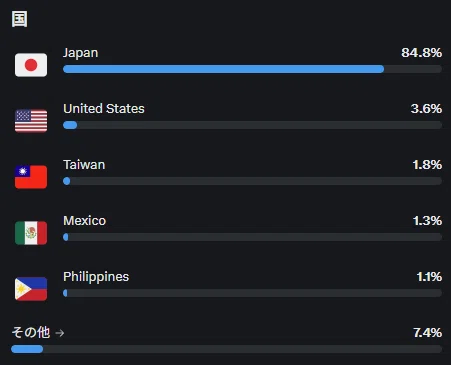
**約85%が「Japan」、つまりホーム地域からですね。**
インプレッション自体が前回スパンよりも少ないので、そもそも収益が減少することを予想していますが…。
どうなるでしょう。
AIイラスト界隈では、**海外ユーザーへのリーチをメインとして活動している人**もいると思います。わたしも一部のモチーフは海外を意識しています。
**収益化している場合、もしもNikita氏がアナウンスしている内容で実施されると、今後は収益が減ることは間違いないと思います。**
海外向けの方がパイが大きいため、フォロワー数もインプレッション数も伸びるので、数万~十数万フォロワー規模の大型アカウントが多い印象です。
奇しくも前述した縦長画像ポストがメインのアカウントと重なりますね。
**最悪なケース想定:**
- 縦長画像が全表示になったことでインプレッション減少
- 海外からの収益ゼロ
- 国内向けに方針転換すると海外フォロワー・インプレッション減少
**フォロワー減、インプレッション減、収益減、というトリプルパンチもあり得そうです。**
## ◆まとめ
- **ホーム地域からのインプレッションに重み付け**
- **ホーム地域外からのインプレッションには収益が発生しない**
- **ホーム地域外へのリーチがメインのアカウントは収益が減少**
- **ホーム地域内へのリーチがメインのアカウントは収益が増加?**
---
## 📝まとめ
個人的に大きな話題が2つ続きました。
**1つ目はAIイラスト界隈にとって、2つ目は収益界隈にとって。**
といっても1つ目の方で影響受ける人は界隈でも一部と思われます。少なくともわたしのおすすめタイムラインに表示される人は該当し無さそう。
2つ目はX全体にかかることなので、影響を受ける人も多そうですね。\
わたしもそうですし。
**冒頭に書いた2つの話題の共通項ですが\
それは「インプレゾンビ対策」だと思います。**
Nikita氏のポストを追っているとわかりますが、とにかくX(Nikita氏)は不正アカウントを撲滅したいのだと思います。
不正をしているユーザーが何かアルゴリズムや収益に関連するポストをすると、**出張って言って直々にBANを告げる**くらいですからね。
睨まれないように気を付けないと。
これもあって、わたしはX公式ポリシーを遵守している、というのもあります。
**いつ目を付けられるかわからないですよ?**
https://x.com/i/status/2030264516953726993
グローバルに活動したい場合に、ホーム地域以外を対象としてコンテンツを展開することは何も不自然なことではないですよね。Xだって広く交流を推奨しているはずですし。
海外では不満が爆発していますが、インプレゾンビ対策としては有効だとわたしは思います。
しかしながら、インプレゾンビの排除を思うがあまり、ユーザーの都合や実情に合わないことを強行しようとした感じは否めないですね。
今のところはイーロンさんがストップをかけてくれたので、「こういう案がある」くらいで思っておくのが良いかもしれません。
[**てんねんのサブスクリプション**](https://x.com/munou_ac/creator-subscriptions/subscribe)\
[**てんねんのnote**](https://note.com/munou_ac)\
[**てんねんのYouTube**](https://www.youtube.com/@10nen_munouAC)\
[**てんねんのPinterest**](https://jp.pinterest.com/munou_ac/)\
[**てんねんのInstagram**](https://www.instagram.com/10nen_/)\
[**てんねんのThreads**](https://www.threads.com/@10nen_)\
[**てんねんの**�](https://x.com/munou_ac)�
## [◆メカ娘](https://x.com/search?q=From%3A%40munou_ac%20filter%3Aimages%20%E3%81%A8%E6%80%9D%E3%81%A3%E3%81%A6%E3%81%84%E3%82%8B%E3%83%A1%E3%82%AB%E5%A8%98&src=recent_search_click&f=live)

黒を基調としたボディスーツ風の装いに、白と黒の機械アーム、赤いネクタイを組み合わせたメカ娘を描いたイラスト。頭部には鋭角なアンテナ状ヘッドギアを装着し、白銀のボブヘアと澄んだ青い瞳がシャープで洗練された印象を与えている。腕部や腰まわりには装甲フレームが組み込まれ、引き締まったシルエットの中に精密なメカ構造が自然に溶け込んでいる。硬質な質感と落ち着いた配色により、可憐さと近未来的な機能美をあわせ持つメカ娘として印象づける構成。
An illustration of a mecha girl wearing a black bodysuit-like outfit combined with white and black mechanical arms and a red necktie. She is equipped with sharp antenna-like headgear, while her silvery bob-cut hair and clear blue eyes create a sharp and refined impression. Armored frames are integrated into her arms and waist, allowing precise mechanical structures to blend naturally into her sleek silhouette. The hard-surface textures and restrained color palette give the character a strong sense of both delicacy and near-future functional beauty.
[メカ娘のポスト一覧](https://x.com/search?q=From%3A%40munou_ac%20filter%3Aimages%20%E3%81%A8%E6%80%9D%E3%81%A3%E3%81%A6%E3%81%84%E3%82%8B%E3%83%A1%E3%82%AB%E5%A8%98&src=recent_search_click&f=live)
## [◆アクションメカ娘](https://x.com/search?q=From%3A%40munou_ac%20filter%3Aimages%20%E3%82%A2%E3%82%AF%E3%82%B7%E3%83%A7%E3%83%B3%E3%83%A1%E3%82%AB%E5%A8%98&src=typed_query&f=live)

刀を頭上に構えた低姿勢のメカ娘を描いたイラスト。セーラー服を基調とした衣装に、機械化された四肢と頭部側面のヘッドギアを組み合わせ、白と金の装甲パーツが引き締まった印象を与えている。橙色に発光する瞳、地面に手をついた構え、静かな表情が合わさり、近接戦闘に特化したメカ娘の緊張感を端正に印象づける一枚。
An illustration of a mecha girl in a low combat stance, holding a sword above her head. Her sailor-style outfit is combined with mechanized limbs and side-mounted headgear, while the white and gold armored parts give her a clean and refined appearance. Her glowing orange eyes, hand-braced posture, and calm expression come together to emphasize the poised tension of a mecha girl specialized for close-quarters combat.
[アクションメカ娘のポスト一覧](https://x.com/search?q=From%3A%40munou_ac%20filter%3Aimages%20%E3%82%A2%E3%82%AF%E3%82%B7%E3%83%A7%E3%83%B3%E3%83%A1%E3%82%AB%E5%A8%98&src=typed_query&f=live)
## [◆ゆるメカ娘](https://x.com/search?q=From%3A%40munou_ac%20filter%3Aimages%20%E7%99%BA%E5%85%89%E3%81%99%E3%82%8B%E3%82%86%E3%82%8B%E3%83%A1%E3%82%AB%E5%A8%98&src=typed_query&f=live)

「翠光の微笑」\
みどりのひかり まなこに宿りて\
からくりの身に やはらかき息満つ\
しろき手 風にゆらぎつつ\
われ いまこの世を愛でむ
発光する角状ユニットと機械フレームを備えたメカ娘の横顔を描いたイラスト。白く長い髪と白い衣装を基調にしながら、首筋から背面にかけて黒い機械構造が露出し、有機的な肌との対比が強い印象を生み出している。緑色に発光する瞳と各部のライトが幻想的かつ近未来的な雰囲気を強調し、穏やかな微笑みが無機質な構造にやわらかさを添えている。暗い背景の中で発光表現と光沢のある質感が際立ち、静謐さと神秘性をあわせ持つメカ娘として印象づける構成。
An illustration of a mecha girl shown in profile, equipped with glowing horn-like units and an exposed mechanical frame. While the design is centered on long white hair and a white outfit, black mechanical structures are revealed from the neck down across her back, creating a striking contrast with her organic skin. Her glowing green eyes and illuminated components enhance the fantastical yet futuristic atmosphere, while her gentle smile adds softness to the otherwise inorganic construction. Against the dark background, the luminous effects and glossy surfaces stand out vividly, shaping her as a mecha girl defined by both serenity and mystery.
[発光するゆるメカ娘一覧](https://x.com/search?q=From%3A%40munou_ac%20filter%3Aimages%20%E7%99%BA%E5%85%89%E3%81%99%E3%82%8B%E3%82%86%E3%82%8B%E3%83%A1%E3%82%AB%E5%A8%98&src=typed_query&f=live)
## [◆女子甲生](https://x.com/search?q=From%3A%40munou_ac%20filter%3Aimages%20%E5%A5%B3%E5%AD%90%E7%94%B2%E7%94%9F&src=typed_query&f=live)

"Still think you can win?"
刀を携えた立ち姿のメカ娘を描いたイラスト。白を基調とした滑らかな装甲外装に、紺、赤、金のアクセントカラーを組み合わせ、細身でしなやかなシルエットの中に高密度な機械構造を組み込んでいる。長い黒髪と青い瞳が静かな存在感を与え、頭部のヘッドギアと背面ユニットが近未来的な印象を強めている。片手に刀を下げた自然な構えと後ろを振り向く視線により、武装感と可憐さをあわせ持つメカ娘として端正にまとめられた構成。
An illustration of a mecha girl standing with a sword in hand. Her design combines smooth white armored exterior panels with navy, red, and gold accent colors, integrating dense mechanical structures into a slender and graceful silhouette. Her long black hair and blue eyes give her a calm presence, while the headgear and rear-mounted unit strengthen the near-future aesthetic. The natural pose with the sword lowered at her side and the glance cast back over her shoulder create a refined composition that balances weaponized detail with delicate charm.
[女子甲生のポスト一覧](https://x.com/search?q=From%3A%40munou_ac%20filter%3Aimages%20%E5%A5%B3%E5%AD%90%E7%94%B2%E7%94%9F&src=typed_query&f=live)
https://x.com/i/status/1889975022850379955
## [◆Samurai Mecha Gril](https://x.com/search?q=From%3A%40munou_ac%20filter%3Aimages%20Samurai%20Mecha%20Girl&src=typed_query&f=live)




[Samurai Mecha Girlのポスト一](https://x.com/search?q=From%3A%40munou_ac%20filter%3Aimages%20Samurai%20Mecha%20Girl&src=typed_query&f=live)
https://x.com/i/status/1889500290073895343
## [◆メカ女子](https://x.com/search?q=From%3A%40munou_ac%20filter%3Aimages%20%E3%83%A1%E3%82%AB%E5%A5%B3%E5%AD%90&src=typed_query&f=live)

青を基調としたセーラー服姿に、大型の頭部装備と下半身の重機械ユニットを組み合わせたメカ女子を描いたイラスト。床に手をついて身を低くした姿勢が印象的で、明るい笑顔と澄んだ青い瞳が親しみやすさを与えている。頭部の装甲ヘルメットと背面へ連結する構造、脚部の高密度な機構パーツが、学生服風デザインの中に強いSF的存在感を加えている。鮮やかな青の配色と柔らかな表情により、可愛らしさと重装メカ感を自然に両立したメカ女子としてまとまった構成。
An illustration of a mecha girl wearing a blue sailor-style school uniform combined with large head-mounted equipment and a heavily mechanized lower body unit. Her low posture with both hands placed on the floor creates a memorable pose, while her bright smile and clear blue eyes give her a friendly and approachable charm. The armored helmet-like headgear, the connected rear structure, and the dense mechanical parts in the legs add a strong science-fiction presence to the school-uniform-inspired design. The vivid blue color scheme and soft expression allow the character to balance cuteness and heavy mechanical appeal in a natural and cohesive way.
[◆メカ女子のポスト一覧](https://x.com/search?q=From%3A%40munou_ac%20filter%3Aimages%20%E3%83%A1%E3%82%AB%E5%A5%B3%E5%AD%90&src=typed_query&f=live)
## [◆Elf Girl](https://x.com/search?q=From%3A%40munou_ac%20filter%3Aimages%20Elven&src=typed_query&f=live)

Please… don’t look at me like that just yet.\
I’m only getting ready, but it still feels a little embarrassing.\
But… I don’t mind you watching me.
本に囲まれて座り込むエルフの少女を描いたイラスト。淡い青緑と白を基調とした衣装に、花飾りを添えた金髪のお団子ヘアがやわらかな印象を与え、長く尖った耳と透き通る青い瞳が幻想的な存在感を際立たせている。周囲には積み重なった書物、開かれた本、羽根ペン、紙片、きのこや蝶が散りばめられ、知性と自然が溶け合う穏やかな世界観を丁寧に形作っている。抱えた膝と控えめな表情が、可憐さと静かな物語性を印象づける構成。
An illustration of an elf girl sitting surrounded by books. Her outfit, based on soft aqua and white tones, along with her blonde updo adorned with flowers, creates a gentle impression, while her long pointed ears and clear blue eyes give her a distinctly fantastical presence. Around her are stacked books, an open volume, quills, scattered papers, mushrooms, and butterflies, carefully shaping a peaceful world where knowledge and nature blend together. Her knees drawn close and her restrained expression give the composition a sense of delicacy and quiet storytelling.
[Elf Girl のポスト一覧](https://x.com/search?q=From%3A%40munou_ac%20filter%3Aimages%20Elven&src=typed_query&f=live)
## [◆失恋ガールズ](https://x.com/search?q=From%3A%40munou_ac%20filter%3Aimages%20%E5%A4%B1%E6%81%8B%E3%82%AC%E3%83%BC%E3%83%AB%E3%82%BA%20OR%20%E4%BB%8A%E6%97%A5%E3%81%AE%E3%81%8B%E3%82%81%E3%81%AF%E3%82%81%E6%B3%A2%20OR%20%E4%BB%8A%E6%97%A5%E3%81%AE%E8%90%8C%E3%81%88%E8%90%8C%E3%81%88%E3%81%8D%E3%82%85%E3%82%93&src=typed_query&f=live)

メイド服姿の少女が膝をつきながら、両手でハート形の魔法陣を描く瞬間を捉えたダイナミックなイラスト。強い眼差しと食いしばった表情が戦闘的な緊張感を生み出し、手元に灯る橙色の炎のハートと周囲を巡る青い光の軌跡が、可憐さと迫力を同時に際立たせている。室内の床に走るひび割れや舞い散る破片、コミカルな吹き出し演出が、激しいアクションとユーモラスな空気を両立させる構成。メイド服のフリルと躍動する髪の流れも印象的な一枚。
A dynamic illustration capturing a maid girl kneeling as she forms a heart-shaped magic sign with both hands. Her intense gaze and clenched expression create strong combat tension, while the orange flaming heart in front of her hands and the blue arc of light circling around her highlight both charm and impact at once. Cracks spreading across the floor, scattered debris, and comic-style speech bubbles balance fierce action with a playful atmosphere. The frills of the maid outfit and the flowing motion of her hair also make the scene especially vivid and memorable.
[失恋ガールズのポスト一覧](https://x.com/search?q=From%3A%40munou_ac%20filter%3Aimages%20%E5%A4%B1%E6%81%8B%E3%82%AC%E3%83%BC%E3%83%AB%E3%82%BA%20OR%20%E4%BB%8A%E6%97%A5%E3%81%AE%E3%81%8B%E3%82%81%E3%81%AF%E3%82%81%E6%B3%A2%20OR%20%E4%BB%8A%E6%97%A5%E3%81%AE%E8%90%8C%E3%81%88%E8%90%8C%E3%81%88%E3%81%8D%E3%82%85%E3%82%93&src=typed_query&f=live)
https://x.com/i/status/1865962033726054450
## [◆X収益額公開中](https://note.com/munou_ac/m/m6cabb21e0c40)
2週間ごとのクリエイター収益を詳細な分析とともに公開しています。4.7万フォロワー、毎日5回のイラストポスト、リプ周り一切無し。Xで収益化をしている方、収益化を目指している方の参考になれば幸いです。 | 2026-03-25T11:30:43Z | 19,911 | 28 | 0 | 1 | 3 | 15 | 1689486406270562304 | |||||
5 | 2010751592346030461 | 2010742786430021632 | How to fix your entire life in 1 day | If you're anything like me, you think new years resolutions are stupid. Because most people go about changing their lives in the completely wrong way. They create these resolutions because everyone el | If you're anything like me, you think new years resolutions are stupid.
Because most people go about changing their lives in the completely wrong way. They create these resolutions because everyone else does – we create a superficial meaning out of status games – but they don’t meet the requirements for true change, which goes a lot deeper than convincing yourself you’re going to be more disciplined or productive this year.
If you're one of these people, I'm not here to talk down on you (I tend to be a bit harsh in my writing). I’ve quit 10x more goals than I’ve achieved. I think that should be the case for most people. But the fact that people try to change their lives and utterly fail almost every time holds true.
However, as much as I think new years resolutions are stupid, it’s always wise to reflect on the life you hate so you can launch yourself toward something that much better, as we will discuss.
So whether you want to start the business, transform your body, or take the risk toward a more meaningful life without quitting after 2 weeks, I want to share 7 ideas you probably haven’t heard before on behavior change, psychology, and productivity so you can do just that in 2026.
This will be comprehensive.
This isn’t one of those letters that you read through and forget about.
This is something you will want to bookmark, take notes on, and set aside time to think about.
The protocol at the end (to dig deep into your psyche and uncover what you truly want in life) will take about a full day to complete, with effects that last far longer than that.
Let’s begin.
I – You aren’t where you want to be because you aren’t the person who would be there
When it comes to setting big goals, people tend to focus on one of the two requirements for success:
Changing your actions to make progress toward the goal (least important, second order)
Changing who you are so that your behavior naturally follows (most important, first order)
Most people set a surface-level goal, hype themselves up to remain disciplined for the first few weeks, then go back to their old ways without much struggle, because they were trying to build a great life on a rotting foundation.
If this doesn’t make sense, let’s run through an example.
Think of somebody successful. It can be a bodybuilder with a great physique, a founder/CEO worth hundreds of millions, or a charismatic dude who can chat up a group without a shred of anxiety entering his mind.
Do you think the bodybuilder has to “grind” to eat healthy? Does the CEO have to discipline themselves to show up and lead the team? To you, it may seem like that on the surface, but the truth is that they can’t see themselves living any other way. The bodybuilder has to grind to eat unhealthily. The CEO has to force themself to lie in bed past their alarm clock, and they hate every second of it (there is nuance here, just entertain me for a second).
To some people, my own lifestyle seems a bit extreme and disciplined. To me, it’s natural, and I don’t say that to contrast it with any other kind of lifestyle. I simply enjoy living this way. When my mom tells me that I should take a break, go out, and have some fun... I hold my tongue from telling her, “If I weren’t having fun, why would I be doing what I’m doing?”
This next sentence may sound simple, but it is baffling how many people don't get it.
If you want a specific outcome in life, you must have the lifestyle that creates that outcome long before you reach it.
If someone says they want to lose 30 pounds, I often don’t believe them. Not because I don’t think they are capable, but because there are too many times when that same person says, “I can’t wait until I'm done losing weight so I can start to enjoy life again.” I hate to break it to you, but if you don’t adopt the lifestyle that led to you losing the weight, for life, and find a reason with a higher gravitational pull than the one tying you to your previous ways, then you will go straight back to where you started, and you can unhappily say that you wasted the resource you will never get back: time.
When you truly change yourself, all of your habits that don’t move the needle toward your goal become disgusting, because you have a deep and profound awareness of what kind of life those actions compound into. You are okay with your current standards because you are not fully aware of what they are or what they lead to. We will discuss how to uncover this, but we need to build up to that.
You say you want to change. You say you want to “become financially free” and “get healthy,” but your actions show otherwise for a reason. And it goes a lot deeper than you think.
II – You aren’t where you want to be because you don’t want to be there
Trust only movement. Life happens at the level of events, not of words. Trust movement.
– Alfred Adler
If you want to change who you are, you must understand how the mind works so that you can start to reprogram it.
The first step to understanding the mind is to understand that all behavior is goal-oriented. It's teleological. When you think about it, this is kinda obvious, but when we dig into it, most people don’t want to hear it.
You take a step forward because you want to reach a certain location.
You scratch your nose because you want to make the itch go away.
Those ones are clear, but most of the time, your goals are unconscious. You may not realize that when you sit on the couch in the middle of the day, you are trying to burn time before your next responsibility, as one simple example.
On an even more unconscious and complex level, you pursue goals that can harm you, but you justify your actions in a way that is socially acceptable and doesn’t make you seem like a loser.
As an example, if you can’t stop procrastinating your work, you may justify it with the fact that you “lack discipline,” but in reality, you are attempting to achieve a goal like you always are. In this case, that goal could be to protect yourself from the judgment that comes from finishing and sharing your work.
If you say you want to quit your dead-end job, but stay in it without any real reason, you may start to think you don’t have enough courage, or that you were never really a “risk taker,” but the truth is that you are pursuing the goal of safety, predictability, and an excuse to not look like a failure to everyone else in your life who sees working a dead-end job as a sign of success.
The lesson here is that real change requires changing your goals.
I don’t mean setting some surface-level goal because the act of doing that serves an unconscious goal that is actually harming you. That’s been ran through enough in the productivity space. I mean changing your point of view. Because that’s what a goal is. A goal is a projection into the future that acts as a lens of perception which allows you to notice information, ideas, and resources that aid in you achieving that goal.
Now let’s dig a bit deeper, because if you don’t understand this, it only becomes more difficult to get out.
I send out letters like these 1-2x a week. If you don’t want to miss them, join here. You can also read my book free, other letters, etc.
III – You aren’t where you want to be because you’re afraid to be there
The important thing for you to remember is that it does not matter in the least how you got the idea or where it came from. You may never have met a professional hypnotist. You may never have been formally hypnotized. But if you have accepted an idea - from yourself, your teachers, your parents, friends, advertisements, from any other source - and further, if you are firmly convinced that idea is true, it has the same power over you as the hypnotist’s words have over the hypnotized subject.
– Maxwell Maltz
Here’s how you’ve become who you are today, and how you will become who you will be tomorrow. This is the anatomy of identity:
You want to achieve a goal
You perceive reality through the lens of that goal
You only notice “important” information and ideas that allows you to achieve that goal (learning)
You act toward that goal and receive feedback that you are progressing toward it
You repeat that behavior until it becomes automatic and unconscious (conditioning)
That behavior becomes a part of who you think you are (”I am the type of person who...”)
You defend your identity to maintain psychological consistency
Your identity shapes new goals, restarting the cycle, and if that identity is disadvantageous toward a good life, this gets bad very quick
The unfortunate reality is that you must break the cycle between steps 6 and 7, but this process starts when you are a child.
You have the goal of survival.
You are dependent on your parents to teach you how to survive. You had to conform. And since the way most people teach is through reward and punishment, unless you adopt their beliefs and values, you will be punished. You don’t actually think for yourself until you see through this.
But your parents have also gone through this process throughout their entire lives. That’s where it can get dangerous. Your parents, unless they broke the pattern themselves, were conditioned by the culturally accepted ideas of success from the Industrial age. They also carry the best and worst conditioning from their parents and their parents’ parents.
To take it a layer deeper, once you fulfill your physical survival needs (which is quite easy to do in today’s world, you’re practically born into safety), you start to survive on the conceptual or ideological level. You may not try to protect and reproduce your body, but you absolutely protect and reproduce your mind. It’s not difficult to see the war of ideas on the internet, and the participants are individual and group identities.
When your body feels threatened, you go into fight or flight.
When your identity feels threatened, the same thing happens.
If you are heavily identified with a political ideology (by the process we talked about just before), you will feel threatened when someone challenges your beliefs. You literally feel the stress. You feel, emotionally, like you were just slapped in the face. Since most people don’t analyze their emotions for truth, you tend to get stuck in echo chambers and double down on claims that harm yourself and others.
If you were raised in a religious household, and did not think for yourself, you will fight and attack others who threaten your psychological safety within that little bubble.
The same thing happens when you unconsciously see yourself as a lawyer, a gamer, or somebody else who would not take the actions to achieve a better life.
IV – The life you want lies within a specific level of mind
The mind evolves through predictable stages over time.
When you’re born, you’re like a little survival sponge that absorbs whatever beliefs you can (which are heavily dictated by your culture) so that you can feel safe and secure. And if you don’t be careful, your mind may crystalize and it may make it difficult to live a meaningful life.
This has been documented enough in models like Maslow’s Hierarchy, Greuter’s stages of ego development, Spiral Dynamics, and Integral Theory, each building off of one another, but it’s also not difficult to observe in society.
I’ve talked about these many times, and synthesized them into my own Human 3.0 model with various AI prompts to uncover your level of development and a path forward (open in a tab to read after if you'd like), but here’s the 80/20 of the 9 stages of ego development as a refresher (because repetition helps reveal things you didn’t notice before, and there are new people reading these letters):
Impulsive — No separation between impulse and action. Black and white thinking. I.e. A toddler hits when angry because the feeling and the behavior are the same thing.
Self-Protective — The world is dangerous and you learn to look out for yourself. I.e. A kid learns to hide report cards, lie about chores, and figure out what adults want to hear.
Conformist — You are your group and its rules feel like reality itself. I.e. Someone who genuinely cannot fathom why anyone would vote differently than their family or group.
Self-Aware — You notice you have an inner life that doesn’t match the exterior. I.e. Sitting in church and realizing you’re not sure you believe what everyone around you seems to believe, but not knowing what to do with that feeling yet.
Conscientious — You build your own system of principles and hold yourself accountable to them. I.e. Leaving your family’s religion after careful study and adopting a personal philosophy you can defend, or building a career plan with clear milestones because you believe the right effort yields the right results.
Individualist — You see that your principles were shaped by context and start holding them more loosely. I.e. Realizing your political views have more to do with where you grew up than objective truth, or noticing that your ambitious career goals were really about earning your father’s approval.
Strategist — You work with systems while aware of your own involvement in them. I.e. Leading an organization while actively questioning your own blind spots, or engaging in politics knowing your perspective is partial and shaped by bias you can’t fully see.
Construct-Aware — You see all frameworks, including your identity, as useful fictions. I.e. Holding your spiritual beliefs with metaphorically not literally, knowing the map is not the territory, or watching yourself play the role of “founder” or “thought leader” with a kind of gentle amusement.
Unitive — Separation between self and life dissolves. I.e. Work, rest, and play feel like the same thing. There’s no one left who needs to become something, just presence responding to what arises.
For most people reading this, I would assume you hover between 4 and 8, which is a huge gap. Those closer to 8 are reading this are doing so to either learn something or pass time in a non-destructive way. Those closer to 4 are really looking for a change. You feel like you are meant for more, but you can’t make sense of everything yet, because there’s obviously a lot at play.
The good thing is, it doesn’t really matter what stage you are in, because moving through any of them follows a pattern.
V – Intelligence is the ability to get what you want out of life
The only real test of intelligence is if you get what you want out of life.
– Naval Ravikant
There is a formula for success.
One ingredient is agency.
One ingredient is opportunity (which many people like to mistake as “privilege” - because they the other ingredients).
The last ingredient is intelligence.
If you have high agency but low opportunity, it doesn’t matter how likely you are to act toward a goal, because it isn’t a goal that will bear much fruit.
If you have opportunity and agency but low intelligence, then you will never be fully able to benefit from that opportunity.
First, we’ve talked about agency before here. In terms of opportunity, I can’t tell you to change your physical location, but if you don’t see the abundance of digital opportunity right in front of you, I don’t know what to tell you.
With that said, I want to focus on what intelligence is in the context of these two other ingredients and this letter. For that, we look to cybernetics.
Cybernetics comes from the greek word kybernetikos which means “to steer” or “good at steering.”
It’s also known as “the art of getting what you want.”
So, if Naval’s definition of intelligence is getting what you want out of life, understanding cybernetics helps you do that much faster.
Cybernetics illustrates the properties of intelligent systems.
To have a goal.
Act toward that goal.
Sense where you are.
Compare it to the goal.
And act again based on that feedback.
You can judge intelligence based on the system’s ability to iterate and persist with trial and error.
A ship blown off course that corrects toward its destination. A thermostat sensing a change in heat and turning on. The pancreas excreting insulin after blood glucose spikes.
What does this have to do with getting what you want out of life?
Everything.
Acting, sensing, comparing, and understanding the system from a meta-perspective is fundamental to high intelligence (with the definition we are using here).
High intelligence is the ability to iterate, persist, and understand the big picture. The mark of low intelligence is the inability to learn from your mistakes.
Low-intelligence people get stuck on problems rather than solving them. They hit a roadblock and quit. Like a writer who fails to build a readership and quits because they lack the ability to try new things, experiment, and figure out a process that works for them (to think that there isn’t an effective process you can create is verifiably false, no matter your limiting beliefs, hence being low intelligence.)
High intelligence is realizing any problem can be solved on a large enough timescale. The reality is that you can achieve any goal you set your mind to.
Intelligence is realizing that there is a series of choices you can make which lead to achieving the goal you want. You understand that ideas are hierarchical and that you can’t go from papyrus to Google docs in one fell swoop. Even if that goal is impossible right now, you simply don’t have the resources – which may be invented over the next few years – to achieve that thing.
When I talk about “goals,” and as I will continue repeating, I am not speaking from the typical lens of self-help, although that’s a helpful lens to adopt at times.
I am speaking from the lens of teleology or the Greek kosmos – that everything serves a purpose. That everything is a part of a greater whole.
Goals determine how you see the world.
Goals determine what you consider “success” or “failure.”
You can try to “enjoy the journey,” but if you pursue the wrong goal, you will not enjoy it.
Your mind is the operating system for reality.
That system is composed of goals.
For most people, those goals are assigned to them. Programmed like lines of code in your psyche.
Go to school. Get the job. Get offended. Play victim. Retire at 65.
A known path that doesn’t work.
To become more intelligent, you must:
Reject the known path
Dive into the unknown
Set new, higher goals to expand your mind
Embrace the chaos and allow for growth
Study the generalized principles of nature
Become a deep generalist
I understand this may not be the traditional definition of intelligence, but that sequence of steps leads to an extraordinary level of connections in your brain, leading to what we would observe as an intelligent person. Pair that with agency and you've got a winner.
That leads us into the next section perfectly.
VI – How to launch into a completely new life (in 1 day)
The best periods of my life always came after a period of getting absolutely fed up with the lack of progress I was making.
How do you dig into your mind?
How do you become aware of your conditioning?
How do you reach profound insights and truths that change the trajectory of your life?
Through the simple, but often painful act of questioning.
Something that so few people do, and you can tell by how they speak or give their thoughts on a specific topic. Questioning is thinking, and very few people do it.
I want to give you a comprehensive protocol that you can use every year to reset your life and launch into a season of intense progress. This protocol helps you ask the right questions.
These questions will cover the macro to the micro: where you want to be, what you need to do to get there, and what you can do immediately to start moving the needle toward that reality.
This will require one full day to complete, so I recommend you follow along with the exact protocol. You will need a pen, paper, and an open mind.
When I observe patterns in people who successfully flip their identity, it happens fast after a build up of tension. Specifically, I’ve noticed 3 phases that people tend to go through.
Dissonance – They feel like they don’t belong in their current life, and become sufficiently fed up with their lack of progress.
Uncertainty – They don’t know what comes next, so they either experiment or get lost and feel worse.
Discovery – They discover what they want to pursue and make 6 years of progress in 6 months.
So, our goal with this protocol is to help you reach the point of dissonance, navigate through uncertainty, and discover what it truly is that you want to achieve, so much so that the clarity is overwhelming and distractions no longer hold their weight.
This protocol is structured so that it can be completed in one day. In the morning, you do a psychological excavation to uncover your own hidden motives. During the day, you prompt yourself with interrupts to keep you out of autopilot and contemplate your life. At night, you synthesize the insights into a direction you will start to move in tomorrow.
I cannot guarantee that this will work for everyone, because I cannot guarantee that everyone reading this is in the right chapter of their own story that would make these points impactful. You can’t place the climax at the start of the book and expect it to be interesting.
Part 1) Morning – Psychological Excavation – Vision & Anti-Vision
First we must create a new frame, or lens of perception, for your mind to operate from.
This is like creating a new shell, leaving your old one, and slowly growing into it over time. It won’t feel like it fits at first. That’s a good thing.
Set aside 15-30 minutes (the length of one YouTube video... you can do it) to think about and answer these questions. Do not attempt to outsource this contemplation to AI. I want you to break past the limiter that is on your mind. If you can’t answer these immediately, come back to them later.
What is the dull and persistent dissatisfaction you’ve learned to live with? Not the deep suffering but what you’ve learned to tolerate. (If you don’t hate it, you will tolerate it)
What do you complain about repeatedly but never actually change? Write down the three complaints you’ve voiced most often in the past year.
For each complaint: What would someone who watched your behavior (not your words) conclude that you actually want?
What truth about your current life would be unbearable to admit to someone you deeply respect?
Those questions are meant to make you aware of the pain in your current life. Now, we need to turn those into what I call an “anti-vision,” which is a brutal awareness of the life you do not want to live. That way, you can use that negative energy to aim your efforts in a positive direction and act from a place of intrinsic motivation.
If absolutely nothing changes for the next five years, describe an average Tuesday. Where do you wake up? What does your body feel like? What’s the first thing you think about? Who’s around you? What do you do between 9am and 6pm? How do you feel at 10pm?
Now do it but for ten years. What have you missed? What opportunities closed? Who gave up on you? What do people say about you when you’re not in the room?
You’re at the end of your life. You lived the safe version. You never broke the pattern. What was the cost? What did you never let yourself feel, try, or become?
Who in your life is already living the future you just described? Someone five, ten, twenty years ahead on the same trajectory? What do you feel when you think about becoming them?
What identity would you have to give up to actually change? (”I am the type of person who...”) What would it cost you socially to no longer be that person?
What is the most embarrassing reason you haven’t changed? The one that makes you sound weak, scared, or lazy rather than reasonable?
If your current behavior is a form of self-protection, what exactly are you protecting? And what is that protection costing you?
If you answered those truthfully, and if you are in the right chapter of your life, you will feel a deep sense of dis-ease and possibly disgust for how you are currently living. Now, we need to orient that energy in a positive direction. We need to create a minimum viable vision, because your vision is like a product. It starts out unclear, but with time and experience, it grows stronger and more potent.
Forget practicality for a minute. If you could snap your fingers and be living a different life in three years, not what’s realistic, what you actually want? What does an average Tuesday look like? Same level of detail as question 5.
What would you have to believe about yourself for that life to feel natural rather than forced? Write the identity statement: “I am the type of person who...”
What is one thing you would do this week if you were already that person?
Answer all of those first thing in the morning tomorrow.
Part 2) Throughout The Day – Interrupting Autopilot – Breaking Unconscious Patterns
These journaling exercises are cute, but we want real change.
Frankly, that’s not going to happen if you don’t break the current unconscious patterns that are keeping you the same.
Throughout the day, I want you to contemplate on everything you journaled in part one. Beyond that, I don’t want you to forget to contemplate. Please take this seriously. You aren’t going to change by doing the same thing for the rest of your life. You need to consciously force a pattern break.
Take the time right now to create reminders or calendar events in your phone. Include the question in the reminder or event so that you can immediately start thinking about it.
The more random and non-conflicting with your schedule there are, the better.
11:00am: What am I avoiding right now by doing what I’m doing?
1:30pm: If someone filmed the last two hours, what would they conclude I want from my life?
3:15pm: Am I moving toward the life I hate or the life I want?
5:00pm: What’s the most important thing I’m pretending isn’t important?
7:30pm: What did I do today out of identity protection rather than genuine desire? (Hint: it’s most things you do)
9:00pm: When did I feel most alive today? When did I feel most dead?
To add a bit more fuel to the fire, schedule these questions during times where you are either commuting, walking, or lying around.
What would change if I stopped needing people to see me as [the identity you wrote in question 10]?
Where in my life am I trading aliveness for safety?
What’s the smallest version of the person I want to become that I could be tomorrow?
Part 3) Evening – Synthesizing Insight – Entering A Season Of Progress
If you followed that process, I would be surprised if you didn’t have at least one profound insight that could alter the course of your life. Now, we need to make those known, integrate them into who we are, and act on them to begin solidifying our journey to a new level of mind.
After today, what feels most true about why you’ve been stuck?
What is the actual enemy? Name it clearly. Not circumstances. Not other people. The internal pattern or belief that has been running the show.
Write a single sentence that captures what you refuse to let your life become. This is your anti-vision compressed. It should make you feel something when you read it.
Write a single sentence that captures what you’re building toward, knowing it will evolve. This is your vision MVP.
Lastly, we need to create goals.
Again, these aren’t goals that you set for the sake of achievement, because goals are just projections. They are unreliable and make you feel bound to something that will inevitably change. Instead, think of goals as a point of view. A lens that you can exchange to enter the right state of mind to perform the action that will lead away from the life you don’t want. Do not worry about some kind of finish line, because as we will find, it doesn’t exist. Enjoyment is found in progress.
One-year lens: What would have to be true in one year for you to know you’ve broken the old pattern? One concrete thing.
One-month lens: What would have to be true in one month for the one-year lens to remain possible?
Daily lens: What are 2-3 actions you can timeblock tomorrow that the person you’re becoming would simply do?
That was a lot.
Hopefully it was helpful.
But we have one last piece to lock it all in.
Stick with me.
VII – Turn Your Life Into A Video Game
The optimal state of inner experience is one in which there is order in consciousness. This happens when psychic energy—or attention—is invested in realistic goals, and when skills match the opportunities for action. The pursuit of a goal brings order in awareness because a person must concentrate attention on the task at hand and momentarily forget everything else.
– Mihaly Csikszentmihalyi
You now have all of the components that lead to a good life.
Now, it may be helpful to organize all of your insights into one coherent plan. Pull out a new page and write down these 6 components:
Anti-vision – What is the bane of my existence, or the life I never want to experience again?
Vision – What is the ideal life that I think I want and can improve as I work toward it?
1 year goal – What will my life look like in 1 year time, and is that closer to the life I want?
1 month project – What do I need to learn? What skills do I need to acquire? What can I build that will move me closer to the one year goal?
Daily levers – What are the priority, needle-moving tasks that bring my project closer to completion?
Constraints – What am I not willing to sacrifice to achieve my vision from the ground up?
Why is this so powerful?
Because these components literally create your own little world. If you are meant to pursue this hierarchy of goals at this stage of your life, you will have no other option but to become obsessed. You will feel the pull to something greater. You will not see anything else as an option.
You turn your life into a video game.
Because games are the poster child for obsession, enjoyment, and flow states. They have all the components that lead to focus and clarity, so if we reverse engineer what those components are, we can live in a state of deeper enjoyment, less distractions, and more success.
Your vision is how you win. At least until the game evolves.
Your anti-vision is what’s at stake. What happens if you lose or give up.
Your 1 year goal is the mission. This is your sole priority in life.
Your 1 month project is the boss fight. How you gain XP and acquire loot.
Your daily levers are the quests. The daily process that unlocks new opportunities.
Your constraints are the rules. The limitations that encourage creativity.
All of these act as a concentric set of circles, like a forcefield, that guard your mind from distractions and shiny objects.
The more you play the game, the stronger this force becomes, and soon enough it becomes who you are, and you wouldn’t have it any other way.
– Dan | If you're anything like me, you think new years resolutions are stupid.
Because most people go about changing their lives in the completely wrong way. They create these resolutions because everyone else does – we create a superficial meaning out of status games – but they don’t meet the requirements for true change, which goes a lot deeper than convincing yourself you’re going to be more disciplined or productive this year.
If you're one of these people, I'm not here to talk down on you (I tend to be a bit harsh in my writing). I’ve quit 10x more goals than I’ve achieved. I think that should be the case for most people. But the fact that people try to change their lives and utterly fail almost every time holds true.
However, as much as I think new years resolutions are stupid, it’s always wise to reflect on the life you hate so you can launch yourself toward something that much better, as we will discuss.
So whether you want to start the business, transform your body, or take the risk toward a more meaningful life without quitting after 2 weeks, I want to share 7 ideas you probably haven’t heard before on behavior change, psychology, and productivity so you can do just that in 2026.
This will be comprehensive.
This isn’t one of those letters that you read through and forget about.
This is something you will want to bookmark, take notes on, and set aside time to think about.
The protocol at the end (to dig deep into your psyche and uncover what you truly want in life) will take about a full day to complete, with effects that last far longer than that.
Let’s begin.
## I – You aren’t where you want to be because you aren’t the person who would be there
When it comes to setting big goals, people tend to focus on one of the two requirements for success:
1. Changing your actions to make progress toward the goal (least important, second order)
2. Changing who you are so that your behavior naturally follows (most important, first order)
Most people set a surface-level goal, hype themselves up to remain disciplined for the first few weeks, then go back to their old ways without much struggle, because they were trying to build a great life on a rotting foundation.
If this doesn’t make sense, let’s run through an example.
Think of somebody successful. It can be a bodybuilder with a great physique, a founder/CEO worth hundreds of millions, or a charismatic dude who can chat up a group without a shred of anxiety entering his mind.
Do you think the bodybuilder has to “grind” to eat healthy? Does the CEO have to discipline themselves to show up and lead the team? To you, it may seem like that on the surface, but the truth is that *they can’t see themselves living any other way.* The bodybuilder has to grind to eat **unhealthily**. The CEO has to force themself to lie in bed past their alarm clock, and they hate every second of it (there is nuance here, just entertain me for a second).
To some people, my own lifestyle seems a bit extreme and disciplined. To me, it’s natural, and I don’t say that to contrast it with any other kind of lifestyle. I simply enjoy living this way. When my mom tells me that I should take a break, go out, and have some fun... I hold my tongue from telling her, “If I weren’t having fun, why would I be doing what I’m doing?”
This next sentence may sound simple, but it is baffling how many people don't get it.
If you want a specific outcome in life, you must have the *lifestyle* that creates that outcome long before you reach it.
If someone says they want to lose 30 pounds, I often don’t believe them. Not because I don’t think they are capable, but because there are too many times when that same person says, “I can’t wait until I'm done losing weight so I can start to enjoy life again.” I hate to break it to you, but if you don’t adopt the lifestyle that led to you losing the weight, for life, and find a *reason with a higher gravitational pull* than the one tying you to your previous ways, then you will go straight back to where you started, and you can unhappily say that you wasted the resource you will never get back: time.
When you truly change yourself, all of your habits that don’t move the needle toward your goal become disgusting, because you have a deep and profound awareness of what kind of life those actions compound into. You are okay with your current standards because you are not fully aware of what they are or what they lead to. We will discuss how to uncover this, but we need to build up to that.
You say you want to change. You say you want to “become financially free” and “get healthy,” but your actions show otherwise for a reason. And it goes a lot deeper than you think.
## II – You aren’t where you want to be because you don’t *want* to be there
> Trust only movement. Life happens at the level of events, not of words. Trust movement.\
> \
> – Alfred Adler
If you want to change who you are, you must understand *how the mind works* so that you can start to reprogram it.
The first step to understanding the mind is to understand that all behavior is goal-oriented. It's teleological. When you think about it, this is kinda obvious, but when we dig into it, most people don’t want to hear it.
You take a step forward because you want to reach a certain location.
You scratch your nose because you want to make the itch go away.
Those ones are clear, but most of the time, your goals are unconscious. You may not realize that when you sit on the couch in the middle of the day, you are trying to burn time before your next responsibility, as one simple example.
On an even more unconscious and complex level, you pursue goals that can harm you, but you justify your actions in a way that is socially acceptable and doesn’t make you seem like a loser.
As an example, if you can’t stop procrastinating your work, you may justify it with the fact that you “lack discipline,” but in reality, you are attempting to achieve a goal like you always are. In this case, that goal could be to *protect yourself from the judgment that comes from finishing and sharing your work.*
If you say you want to quit your dead-end job, but stay in it without any real reason, you may start to think you don’t have enough courage, or that you were never really a “risk taker,” but the truth is that you are pursuing the goal of safety, predictability, and an excuse to not look like a failure to everyone else in your life who sees working a dead-end job as a sign of success.
The lesson here is that real change requires changing your goals.
I don’t mean *setting* some surface-level goal *because the act of doing that serves an unconscious goal that is actually harming you*. That’s been ran through enough in the productivity space. I mean changing your *point of view.* Because that’s what a goal is. A goal is a projection into the future that acts as a lens of perception which allows you to notice information, ideas, and resources that aid in you achieving that goal.
Now let’s dig a bit deeper, because if you don’t understand this, it only becomes more difficult to get out.
---
I send out letters like these 1-2x a week. If you don’t want to miss them, [join here.](https://letters.thedankoe.com) You can also read my book free, other letters, etc.
---
## III – You aren’t where you want to be because you’re afraid to be there
> The important thing for you to remember is that it does not matter in the least how you got the idea or where it came from. You may never have met a professional hypnotist. You may never have been formally hypnotized. But if you have accepted an idea - from yourself, your teachers, your parents, friends, advertisements, from any other source - and further, if you are firmly convinced that idea is true, it has the same power over you as the hypnotist’s words have over the hypnotized subject.\
> \
> – Maxwell Maltz
Here’s how you’ve become who you are today, and how you will become who you will be tomorrow. This is the anatomy of identity:
1. You want to achieve a goal
2. You perceive reality through the lens of that goal
3. You only notice “important” information and ideas that allows you to achieve that goal (learning)
4. You act toward that goal and receive feedback that you are progressing toward it
5. You repeat that behavior until it becomes automatic and unconscious (conditioning)
6. That behavior becomes a part of who you think you are (”I am the type of person who...”)
7. You defend your identity to maintain psychological consistency
8. Your identity shapes new goals, restarting the cycle, and if that identity is disadvantageous toward a good life, this gets bad very quick
The unfortunate reality is that you must break the cycle between steps 6 and 7, but this process starts when you are a child.
You have the goal of survival.
You are dependent on your parents to teach you how to survive. You had to conform. And since the way most people teach is through reward and punishment, unless you adopt their beliefs and values, you will be punished. You don’t actually think for yourself until you see through this.
But your parents have also gone through this process throughout their entire lives. That’s where it can get dangerous. Your parents, unless they broke the pattern themselves, were conditioned by the culturally accepted ideas of success from the Industrial age. They also carry the best and worst conditioning from their parents and their parents’ parents.
To take it a layer deeper, once you fulfill your physical survival needs (which is quite easy to do in today’s world, you’re practically born into safety), you start to survive on the conceptual or ideological level. You may not try to protect and reproduce your body, but you absolutely protect and reproduce your mind. It’s not difficult to see the war of ideas on the internet, and the participants are individual and group identities.
When your body feels threatened, you go into fight or flight.
When your identity feels threatened, the same thing happens.
If you are heavily identified with a political ideology (by the process we talked about just before), you will feel threatened when someone challenges your beliefs. You literally feel the stress. You feel, emotionally, like you were just slapped in the face. Since most people don’t analyze their emotions for truth, you tend to get stuck in echo chambers and double down on claims that harm yourself and others.
If you were raised in a religious household, and did not think for yourself, you will fight and attack others who threaten your psychological safety within that little bubble.
The same thing happens when you unconsciously see yourself as a lawyer, a gamer, or somebody else who would not take the actions to achieve a better life.
## IV – The life you want lies within a specific level of mind
The mind evolves through predictable stages over time.
When you’re born, you’re like a little survival sponge that absorbs whatever beliefs you can (which are heavily dictated by your culture) so that you can feel safe and secure. And if you don’t be careful, your mind may crystalize and it may make it difficult to live a meaningful life.
This has been documented enough in models like Maslow’s Hierarchy, Greuter’s stages of ego development, Spiral Dynamics, and Integral Theory, each building off of one another, but it’s also not difficult to observe in society.
I’ve talked about these many times, and synthesized them into my own [Human 3.0 model](https://letters.thedankoe.com/p/human-30-a-map-to-reach-the-top-1?lli=1) with various AI prompts to uncover your level of development and a path forward (open in a tab to read after if you'd like), but here’s the 80/20 of the 9 stages of ego development as a refresher (because repetition helps reveal things you didn’t notice before, and there are new people reading these letters):
1. **Impulsive** — No separation between impulse and action. Black and white thinking. *I.e. A toddler hits when angry because the feeling and the behavior are the same thing.*
2. **Self-Protective** — The world is dangerous and you learn to look out for yourself. *I.e. A kid learns to hide report cards, lie about chores, and figure out what adults want to hear.*
3. **Conformist** — You are your group and its rules feel like reality itself. *I.e. Someone who genuinely cannot fathom why anyone would vote differently than their family or group.*
4. **Self-Aware** — You notice you have an inner life that doesn’t match the exterior. *I.e. Sitting in church and realizing you’re not sure you believe what everyone around you seems to believe, but not knowing what to do with that feeling yet.*
5. **Conscientious** — You build your own system of principles and hold yourself accountable to them. *I.e. Leaving your family’s religion after careful study and adopting a personal philosophy you can defend, or building a career plan with clear milestones because you believe the right effort yields the right results.*
6. **Individualist** — You see that your principles were shaped by context and start holding them more loosely. *I.e. Realizing your political views have more to do with where you grew up than objective truth, or noticing that your ambitious career goals were really about earning your father’s approval.*
7. **Strategist** — You work with systems while aware of your own involvement in them. *I.e. Leading an organization while actively questioning your own blind spots, or engaging in politics knowing your perspective is partial and shaped by bias you can’t fully see.*
8. **Construct-Aware** — You see all frameworks, including your identity, as useful fictions. *I.e. Holding your spiritual beliefs with metaphorically not literally, knowing the map is not the territory, or watching yourself play the role of “founder” or “thought leader” with a kind of gentle amusement.*
9. **Unitive** — Separation between self and life dissolves. *I.e. Work, rest, and play feel like the same thing. There’s no one left who needs to become something, just presence responding to what arises.*
For most people reading this, I would assume you hover between 4 and 8, which is a huge gap. Those closer to 8 are reading this are doing so to either learn something or pass time in a non-destructive way. Those closer to 4 are really looking for a change. You feel like you are meant for more, but you can’t make sense of everything yet, because there’s obviously a lot at play.
The good thing is, it doesn’t really matter what stage you are in, because moving through any of them follows a pattern.
## V – Intelligence is the ability to get what you want out of life
> The only real test of intelligence is if you get what you want out of life.\
> \
> – Naval Ravikant
There is a formula for success.
One ingredient is **agency**.
One ingredient is **opportunity** (which many people like to mistake as “privilege” - because they the other ingredients).
The last ingredient is **intelligence**.
If you have high agency but low opportunity, it doesn’t matter how likely you are to act toward a goal, because it isn’t a goal that will bear much fruit.
If you have opportunity and agency but low intelligence, then you will never be fully able to benefit from that opportunity.
First, we’ve talked about agency before here. In terms of opportunity, I can’t tell you to change your physical location, but if you don’t see the abundance of digital opportunity right in front of you, I don’t know what to tell you.
With that said, I want to focus on *what intelligence is* in the context of these two other ingredients and this letter. For that, we look to cybernetics.
> Cybernetics comes from the greek word *kybernetikos* which means “to steer” or “good at steering.”
It’s also known as “the art of getting what you want.”
So, if Naval’s definition of intelligence is getting what you want out of life, understanding cybernetics helps you do that much faster.
Cybernetics illustrates the properties of intelligent systems.
- To have a goal.
- Act toward that goal.
- Sense where you are.
- Compare it to the goal.
- And act again based on that feedback.
*You can judge intelligence based on the system’s ability to iterate and persist with trial and error.*
A ship blown off course that corrects toward its destination. A thermostat sensing a change in heat and turning on. The pancreas excreting insulin after blood glucose spikes.
What does this have to do with getting what you want out of life?
Everything.
Acting, sensing, comparing, and understanding the system from a meta-perspective is fundamental to high intelligence (with the definition we are using here).
High intelligence is the ability to iterate, persist, and understand the big picture. **The mark of low intelligence is the inability to learn from your mistakes.**
Low-intelligence people get stuck on problems rather than solving them. They hit a roadblock and quit. Like a writer who fails to build a readership and quits because they lack the ability to try new things, experiment, and figure out a process that works for them (to think that there isn’t an effective process you can create is verifiably false, no matter your limiting beliefs, hence being low intelligence.)
High intelligence is realizing any problem can be solved on a large enough timescale. The reality is that you can achieve any goal you set your mind to.
Intelligence is realizing that *there is* a series of choices you can make which lead to achieving the goal you want. You understand that ideas are hierarchical and that you can’t go from papyrus to Google docs in one fell swoop. Even if that goal is impossible right now, you simply don’t have the resources – which may be invented over the next few years – to achieve that thing.
When I talk about “goals,” and as I will continue repeating, I am not speaking from the typical lens of self-help, although that’s a helpful lens to adopt at times.
I am speaking from the lens of *teleology* or the Greek *kosmos* – that everything serves a *purpose*. That everything is a part of a greater whole.
Goals determine how you see the world.
Goals determine what you consider “success” or “failure.”
You can try to “enjoy the journey,” but if you pursue the wrong goal, you will not enjoy it.
Your mind is the operating system for reality.
That system is composed of goals.
For most people, those goals are assigned to them. Programmed like lines of code in your psyche.
*Go to school. Get the job. Get offended. Play victim. Retire at 65.*
A known path that doesn’t work.
To become more intelligent, you must:
- Reject the known path
- Dive into the unknown
- Set new, higher goals to expand your mind
- Embrace the chaos and allow for growth
- Study the generalized principles of nature
- Become a deep generalist
I understand this may not be the traditional definition of intelligence, but that sequence of steps leads to an extraordinary level of connections in your brain, leading to what we would observe as an intelligent person. Pair that with agency and you've got a winner.
That leads us into the next section perfectly.
## VI – How to launch into a completely new life (in 1 day)
> The best periods of my life always came after a period of getting absolutely fed up with the lack of progress I was making.
How do you dig into your mind?
How do you become aware of your conditioning?
How do you reach profound insights and truths that change the trajectory of your life?
Through the simple, but often painful act of *questioning.*
Something that so few people do, and you can tell by how they speak or give their thoughts on a specific topic. Questioning is thinking, and very few people do it.
I want to give you a comprehensive protocol that you can use every year to reset your life and launch into a season of intense progress. This protocol helps you ask the right questions.
These questions will cover the macro to the micro: where you want to be, what you need to do to get there, and what you can do immediately to start moving the needle toward that reality.
This will require one full day to complete, so I recommend you follow along with the exact protocol. You will need a pen, paper, and an open mind.
When I observe patterns in people who successfully flip their identity, it happens fast after a build up of tension. Specifically, I’ve noticed 3 phases that people tend to go through.
1. **Dissonance** – They feel like they don’t belong in their current life, and become sufficiently fed up with their lack of progress.
2. **Uncertainty** – They don’t know what comes next, so they either experiment or get lost and feel worse.
3. **Discovery** – They discover what they want to pursue and make 6 years of progress in 6 months.
So, our goal with this protocol is to help you reach the point of dissonance, navigate through uncertainty, and discover what it truly is that you want to achieve, so much so that the clarity is overwhelming and distractions no longer hold their weight.
This protocol is structured so that it can be completed in one day. In the morning, you do a psychological excavation to uncover your own hidden motives. During the day, you prompt yourself with interrupts to keep you out of autopilot and contemplate your life. At night, you synthesize the insights into a direction you will start to move in tomorrow.
I cannot guarantee that this will work for everyone, because I cannot guarantee that everyone reading this is in the right chapter of their own story that would make these points impactful. You can’t place the climax at the start of the book and expect it to be interesting.
**Part 1) Morning – Psychological Excavation – Vision & Anti-Vision**
First we must create a new frame, or lens of perception, for your mind to operate from.
This is like creating a new shell, leaving your old one, and slowly growing into it over time. It won’t feel like it fits at first. That’s a good thing.
Set aside 15-30 minutes (the length of one YouTube video... you can do it) to think about and answer these questions. Do not attempt to outsource this contemplation to AI. I want you to break past the limiter that is on your mind. If you can’t answer these immediately, come back to them later.
1. What is the dull and persistent dissatisfaction you’ve learned to live with? Not the deep suffering but what you’ve learned to tolerate. (If you don’t hate it, you will tolerate it)
2. What do you complain about repeatedly but never actually change? Write down the three complaints you’ve voiced most often in the past year.
3. For each complaint: What would someone who watched your behavior (not your words) conclude that you actually want?
4. What truth about your current life would be unbearable to admit to someone you deeply respect?
Those questions are meant to make you aware of the pain in your current life. Now, we need to turn those into what I call an “anti-vision,” which is a brutal awareness of the life you do not want to live. That way, you can use that negative energy to aim your efforts in a positive direction and act from a place of intrinsic motivation.
1. If absolutely nothing changes for the next five years, describe an average Tuesday. Where do you wake up? What does your body feel like? What’s the first thing you think about? Who’s around you? What do you do between 9am and 6pm? How do you feel at 10pm?
2. Now do it but for ten years. What have you missed? What opportunities closed? Who gave up on you? What do people say about you when you’re not in the room?
3. You’re at the end of your life. You lived the safe version. You never broke the pattern. What was the cost? What did you never let yourself feel, try, or become?
4. Who in your life is already living the future you just described? Someone five, ten, twenty years ahead on the same trajectory? What do you feel when you think about becoming them?
5. What identity would you have to give up to actually change? (”I am the type of person who...”) What would it cost you socially to no longer be that person?
6. What is the most embarrassing reason you haven’t changed? The one that makes you sound weak, scared, or lazy rather than reasonable?
7. If your current behavior is a form of self-protection, what exactly are you protecting? And what is that protection costing you?
If you answered those truthfully, and if you are in the right chapter of your life, you will feel a deep sense of dis-ease and possibly disgust for how you are currently living. Now, we need to orient that energy in a positive direction. We need to create a minimum viable vision, because your vision is like a product. It starts out unclear, but with time and experience, it grows stronger and more potent.
1. Forget practicality for a minute. If you could snap your fingers and be living a different life in three years, not what’s realistic, what you actually *want*? What does an average Tuesday look like? Same level of detail as question 5.
2. What would you have to believe about yourself for that life to feel natural rather than forced? Write the identity statement: “I am the type of person who...”
3. What is one thing you would do this week if you were already that person?
Answer all of those first thing in the morning tomorrow.
**Part 2) Throughout The Day – Interrupting Autopilot – Breaking Unconscious Patterns**
These journaling exercises are cute, but we want real change.
Frankly, that’s not going to happen if you don’t break the current unconscious patterns that are keeping you the same.
Throughout the day, I want you to contemplate on everything you journaled in part one. Beyond that, I don’t want you to forget to contemplate. Please take this seriously. You aren’t going to change by doing the same thing for the rest of your life. You need to consciously force a pattern break.
Take the time right now to create reminders or calendar events in your phone. Include the question in the reminder or event so that you can immediately start thinking about it.
The more random and non-conflicting with your schedule there are, the better.
- **11:00am:** What am I avoiding right now by doing what I’m doing?
- **1:30pm:** If someone filmed the last two hours, what would they conclude I want from my life?
- **3:15pm:** Am I moving toward the life I hate or the life I want?
- **5:00pm:** What’s the most important thing I’m pretending isn’t important?
- **7:30pm:** What did I do today out of identity protection rather than genuine desire? (Hint: it’s most things you do)
- **9:00pm:** When did I feel most alive today? When did I feel most dead?
To add a bit more fuel to the fire, schedule these questions during times where you are either commuting, walking, or lying around.
- What would change if I stopped needing people to see me as \[the identity you wrote in question 10\]?
- Where in my life am I trading aliveness for safety?
- What’s the smallest version of the person I want to become that I could be tomorrow?
**Part 3) Evening – Synthesizing Insight – Entering A Season Of Progress**
If you followed that process, I would be surprised if you didn’t have at least *one* profound insight that could alter the course of your life. Now, we need to make those known, integrate them into who we are, and act on them to begin solidifying our journey to a new level of mind.
1. After today, what feels most true about why you’ve been stuck?
2. What is the actual enemy? Name it clearly. Not circumstances. Not other people. The internal pattern or belief that has been running the show.
3. Write a single sentence that captures what you refuse to let your life become. This is your anti-vision compressed. It should make you feel something when you read it.
4. Write a single sentence that captures what you’re building toward, knowing it will evolve. This is your vision MVP.
Lastly, we need to create goals.
Again, these aren’t goals that you set for the sake of achievement, because goals are just projections. They are unreliable and make you feel bound to something that will inevitably change. Instead, think of goals as a point of view. A lens that you can exchange to enter the right state of mind to perform the action that will lead away from the life you don’t want. Do not worry about some kind of finish line, because as we will find, it doesn’t exist. Enjoyment is found in progress.
1. **One-year lens:** What would have to be true in one year for you to know you’ve broken the old pattern? One concrete thing.
2. **One-month lens:** What would have to be true in one month for the one-year lens to remain possible?
3. **Daily lens:** What are 2-3 actions you can timeblock tomorrow that the person you’re becoming would simply do?
That was a lot.
Hopefully it was helpful.
But we have one last piece to lock it all in.
Stick with me.
## VII – Turn Your Life Into A Video Game
> The optimal state of inner experience is one in which there is order in consciousness. This happens when psychic energy—or attention—is invested in realistic goals, and when skills match the opportunities for action. The pursuit of a goal brings order in awareness because a person must concentrate attention on the task at hand and momentarily forget everything else.\
> \
> – Mihaly Csikszentmihalyi
You now have all of the components that lead to a good life.
Now, it may be helpful to organize all of your insights into one coherent plan. Pull out a new page and write down these 6 components:
- **Anti-vision** – What is the bane of my existence, or the life I never want to experience again?
- **Vision** – What is the ideal life that I think I want and can improve as I work toward it?
- **1 year goal** – What will my life look like in 1 year time, and is that closer to the life I want?
- **1 month project** – What do I need to learn? What skills do I need to acquire? What can I build that will move me closer to the one year goal?
- **Daily levers** – What are the priority, needle-moving tasks that bring my project closer to completion?
- **Constraints** – What am I not willing to sacrifice to achieve my vision from the ground up?
Why is this so powerful?
Because these components literally create your own little world. If you are meant to pursue this hierarchy of goals at this stage of your life, you will have no other option but to become obsessed. You will feel the pull to something greater. You will not see anything else as an option.
You turn your life into a video game.
Because games are the poster child for obsession, enjoyment, and flow states. They have all the components that lead to focus and clarity, so if we reverse engineer what those components are, we can live in a state of deeper enjoyment, less distractions, and more success.
Your vision is how you **win**. At least until the game evolves.
Your anti-vision is what’s at **stake**. What happens if you lose or give up.
Your 1 year goal is the **mission**. This is your sole priority in life.
Your 1 month project is the **boss fight**. How you gain XP and acquire loot.
Your daily levers are the **quests**. The daily process that unlocks new opportunities.
Your constraints are the **rules**. The limitations that encourage creativity.
All of these act as a concentric set of circles, like a forcefield, that guard your mind from distractions and shiny objects.
The more you play the game, the stronger this force becomes, and soon enough it becomes who you are, and you wouldn’t have it any other way.
– Dan | 2026-01-12T16:31:52Z | 252,227,021 | 371,626 | 60,484 | 9,538 | 16,316 | 976,263 | 256523056 |



Playground
Run this API
Input Form
Fill in the fields below or .
0.45¢ per article
Est. up to$0.00451 articles
live
curl -X POST "https://api.mindcase.co/v1/data/twitter/articles/run?wait=true" \
  -H "Authorization: Bearer mk_live_YOUR_API_KEY" \
  -H "Content-Type: application/json" \
  -d '{
  "params": {
    "urls": []
  }
}'
Edit the form to update this live.
Related
Related APIs
Twitter / X Followers API
A Twitter (X) account's followers or following as full profiles: bio, counts, location, links, account age and latest tweet. From a handle or URL.
Twitter / X0.025¢ per profile
Twitter / X Profiles API
Twitter (X) profiles: bio, follower counts, verification type, location and links. By handle, profile URL or keyword search; same record either way.
Twitter / X0.05¢ per profile
Twitter / X Replies API
Every reply to a tweet as a full tweet record: author, engagement, media, quotes. The original is included, flagged so you can tell them apart.
Twitter / X0.025¢ per reply
Twitter / X Retweeters API
Everyone who retweeted a tweet, each as a full Twitter (X) profile with handle, name, bio, follower counts, verification, location and links.
Twitter / X0.025¢ per profile
Twitter Trends API
Trending topics on X (Twitter) with rank, URL and hashtag and promoted flags. Pick worldwide, a country or a major city.
Twitter / X0.1¢ per trend
Twitter / X Tweets API
Extract tweets from Twitter (X) by handle, search keyword, or tweet URL, with full text, date, media, quoted/retweeted content, and all engagement metrics
Twitter / X0.025¢ per tweet
Guides
Twitter / X guides
Getting Twitter/X Data Without Hitting API Tier Limits
X's own API gates real search and volume behind paid tiers. Here's how to pull tweets and profiles without one.
twitterproduct
An Alternative to Building a Twitter/X Listening Tool
X's own API is pay-per-read now, with a 2 million-read monthly cap before you're pushed to Enterprise pricing. Here's what building against it yourself actually costs.
twitterproduct